
Immigration Waivers
If you’ve ever made an immigration mistake, entered the country illegally, or faced deportation, you may still have a chance to fix your situation. This is known as the immigration waiver or immigration waiver.
This legal process allows you to ask the government to overlook certain faults of the past and give you a new chance to move on with your life in the United States, together with your family.
In this guide we explain, in simple words:
- What is the immigration waiver?
- Who can apply
- What are the types of immigration waivers?
- What documents you need
- What to do if you already have a deportation
- And why it’s important to do it with professional help
At Lorenzo Law Group / Immigration Lawyers, our goal is for you to understand your rights and know what steps to take if you are thinking of applying for an immigration waiver.
What is an Immigration Waiver?
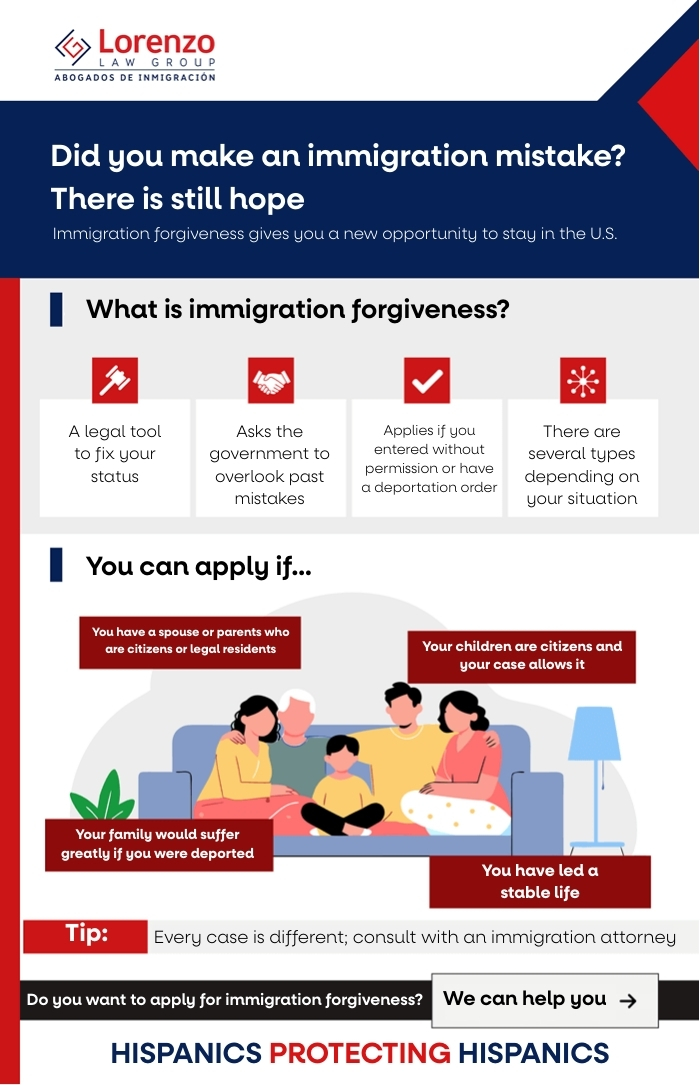
An immigration waiver, also known as a waiver, is a legal tool that allows you to ask the U.S. government to overlook certain immigration mistakes of the past.
This forgiveness can help you if:
- You entered the country without authorization.
- You overstayed your visa.
- You have a deportation order.
- You were detained at the border by immigration.
- You committed certain crimes that affect your immigration history.
Bottom line: Immigration forgiveness gives you a second chance. It does not erase what happened, but it does tell the government that you have valid reasons to stay in the country or continue with your immigration process.
There are different types of immigration waivers, and each one is used depending on your situation. For example, the I-601 immigration waiver is used when you want to fix your status from outside the country, while the I-601A focuses on people who are inside the U.S. and want to avoid a prolonged separation from their family.
Who can apply for a waiver from immigration?
Not everyone qualifies, but many do, especially if they have family members who depend on them.
You can ask for a pardon if:
- You have a U.S. citizen or permanent resident spouse.
- Your parents are citizens or permanent residents.
- Your children are U.S. citizens and your case allows it.
- You have a deportation order but you can show that your family would suffer a lot without you.
You can also apply if you made certain immigration mistakes in the past but lead a stable life, have family in the U.S., and can show that you deserve another chance.
Each case is different. Asking for a waiver from immigration is not easy, but it is possible if you are well oriented. Therefore, it is key to speak with an attorney who is well-versed in immigration law and the waiver processes.
Types of Immigration Waivers
There are different types of immigration waivers, and each one is used based on the reason you need legal help to pursue your case. Here are the most common ones in a simple way:
This is one of the most well-known pardons. It is used when:
- You were denied a visa because you lived in the U.S. without permission.
- You left the country and now you can’t go back without a pardon.
- You are accused of fraud or lying on an immigration application.
- You committed certain crimes and need an immigration waiver to continue your process.
If you are inside the United States and need to leave to fix your residency, you can apply for this waiver before you leave, to avoid a punishment of 3 or 10 years outside the country.
This immigration waiver applies to:
- Persons with unlawful presence.
- People who want to avoid a long separation from their family.
- Cases where the family member would suffer a lot if you are not there.
If you were deported and wish to return to the United States legally, you need an immigration waiver for deportation. This process is also known as reentry after deportation, and it requires showing that your return is necessary and justified.
Depending on the case, there are other types of less common immigration waivers, such as:
- Forgiveness for people with criminal records.
- Forgiveness for marriage-related fraud.
- Waiver for asylum or refugee seekers.
Tip: Every forgiveness is different. The most important thing is to know which one applies to you and how to prepare it correctly. A mistake can delay your case or cause a new denial.
How to Apply for an Immigration Waiver?
Asking for an immigration waiver may seem complicated, but you are not alone. With the right guidance, it is possible to do it step by step.
Here’s how to apply for an immigration waiver, without beating around the bush or tough words.
1. Check if you Qualify
The first thing is to know if you can apply.
For that, a lawyer must analyze your immigration history and your family situation.
For example:
- Do you have a citizen or resident spouse, parent, or parent who would suffer if you were not there?
- Were you deported or were you in the U.S. without permission?
- Did you make a mistake, but you already have a stable life here?
If any of these apply, you may be eligible to apply for an immigration waiver.
2. Choose the Right Type of Forgiveness
Not all immigration waivers are created equal. You must choose the correct one:
- If you are out of the country and were denied a visa, you probably need the I-601 immigration waiver.
- If you are inside the country but have unlawful presence, you may qualify for the I-601A.
- If you were deported, you will need an immigration waiver for deportation.
3. Gather your documents and fill out the form
Once you know what waiver you need, the next step is to fill out the correct form and prepare the documents. This is where the next section comes in:
Documents You Must Have
To apply for a waiver from immigration, it is not enough to fill out a form. You need to prove your case with strong, clear evidence.
Here are some of the most important documents:
- Birth or marriage certificates that prove your relationship to the citizen or resident family member.
- Evidence of the extreme suffering your family member would have if you were unable to stay (e.g., illness, financial problems, mental health).
- Medical history if there are chronic illnesses or expensive treatments.
- Letters of support from family, friends, religious leaders, or your community.
- Proof of work and economic stability (pay stubs, taxes, etc.).
- Legal documents such as deportation orders, entries and exits from the country, criminal records, if any.
- Rehabilitation tests, if you had a problem with the law (therapies, certificates, etc.).
The stronger your evidence, the better your chances of being pardoned.
This process can take several months and requires a lot of precision. It’s not something you should do alone. A small mistake can cause denial, and you could lose the opportunity to be with your family.
From the team at Lorenzo Law Group / Immigration Lawyers, we accompany you at every step so that you can file a solid immigration waiver. We offer an award-winning service and dedicated to working to make the most of the chance of success.
Aspects of Ineligibility for an Immigration Waiver
Although many can benefit from immigration waiver, there are situations where the government does not allow a person to apply for it.
Here are some of the most common reasons why someone is not eligible to apply for an immigration waiver:
Common Grounds for Ineligibility
- Being deported more than once: If you were deported multiple times, you could be permanently barred from returning to the country.
- Illegal reentry after deportation: Entering the U.S. without permission after being deported can block your ability to obtain an immigration waiver.
- Having a serious record: Certain crimes such as drug trafficking, violence, sexual abuse, or involvement in criminal activity can prevent you from getting a waiver.
- Immigration fraud with no applicable exception: If you committed fraud or lied to immigration and you don’t have a qualifying family member who suffers without you, you may not be eligible.
- Failing to show extreme hardship: If you cannot prove that your resident or citizen family member would suffer greatly if you were denied, the waiver may be rejected.
- Lack of a qualifying relative: Some waivers require you to have a citizen or lawful permanent resident spouse, parent. If you don’t have that connection, you can’t apply for certain waivers.
Case-by-Case Evaluation
Every immigration situation is unique. Although there are general rules, it is always advisable to have an attorney review your case. Sometimes, what seems like a cause of ineligibility has a solution. On other occasions, you can wait a certain time or look for another legal way to continue.
Knowing what the immigration waiver consists of also implies understanding when it cannot be requested. That’s why getting professional advice from the beginning gives you clarity and avoids complications.
Immigration Forgiveness: Frequently Asked Questions
If you are considering applying for a waiver from immigration, it is normal to have many doubts. This process may seem complicated, and every case is different. However, there are questions that many people ask themselves over and over again.
Here we answer the most common questions about the immigration waiver, to help you better understand your options, clear up confusion, and make informed decisions.
From what the immigration waiver consists of, to how long the process takes or what happens if it is denied, we are going to explain everything in simple and easy-to-understand words.
In some cases, yes, an immigration waiver can help you avoid deportation or even reopen your case if you already have an exit order.
However, it all depends on your specific situation:
- If you already have a final order of removal, not all waivers apply. In that case, you may need a motion to reopen your case and then apply for immigration waiver for deportation.
- If you are in removal proceedings but there is still no final decision, an immigration waiver may be part of your defense before the judge.
- If you are applying for a green card and have an immigration penalty for illegal entries or presence without permission, the I-601 or I-601A immigration waiver can help you continue with your process without being deported.
It is important to clarify that:
- Forgiveness does not automatically stop a deportation.
- It’s not a protection like asylum or DACA.
- This is a resource that you must request correctly and with solid evidence.
In most cases, you cannot apply for an immigration waiver directly for a family member. Immigration waivers are personal. Only the person who committed the immigration violation is the one who must apply for an immigration waiver for themselves.
However, your family does play a key role in the process. How? We explain:
- For many waivers, such as the I-601 or I-601A immigration waiver, you need to show that a relative of yours (spouse, parent who is a citizen or permanent resident) would suffer extreme harm if you are not waived.
- Although you can’t fill out the form for them, their emotional, medical, or financial situation can help justify why the government should give you a second chance.
That is:
- You ask for forgiveness, but you do so based on the impact your absence would have on your family.
- It is not a forgiveness for them, but a forgiveness that benefits you thanks to your relationship with them.
The time it takes for an immigration waiver to be approved can vary quite a bit. There is no exact answer for all cases, but here is a general idea:
Approximate times according to the type of forgiveness
- I-601 Immigration Waiver: It usually takes between 8 and 14 months, depending on the USCIS workload and whether you submitted all the documents correctly.
- I-601A (provisional) waiver: It usually takes between 12 and 18 months. This waiver is requested from within the U.S. and is very common in marriage residency processes.
- Immigration waiver for deportation: this can take several months or more than a year, since many times it also depends on the immigration court.
Is it worth the wait?
Yes, in many cases it is worth it. Although the wait can be long, an approved immigration waiver opens the door to continuing your legal process, obtaining your residency, or avoiding immigration punishment.
It depends on your immigration status. Not everyone who applies for an immigration waiver has to leave the country. But in some cases, it is necessary to leave temporarily to complete the process.
Here are the most common situations:
Cases where you should leave
- If you are applying for residency through a family member and entered without a visa, you will likely have to leave the country for your interview at the consulate.
- In these cases, you can apply for the I-601A immigration waiver before leaving, so that you do not get the 3 or 10-year bar for having been without permission.
- Once the provisional waiver is approved, you leave for your appointment and, if all goes well, you return legally and with your residence approved.
Yes, but the immigration waiver does not automatically make you a citizen. It’s just the first step in being able to fix your legal status and, eventually, walk toward citizenship.
Here’s how the process usually works:
- Forgiveness opens the door for you
When your waiver or immigration waiver is approved, you are resolving an obstacle that prevented you from continuing with your immigration process. For example:
- If you had been punished for being without papers.
- If you had an old deportation.
- If you had made an immigration mistake.
Once the waiver is approved, you can continue with your legal permanent residency process.
- Then you get the residency
After forgiveness, if all goes well, you get your Green Card. With it you are already legally protected, you can work, travel and live in the US without fear.
- After a few years, you can apply for citizenship
Once you have your residency, you can apply for citizenship:
- If you are married to a U.S. citizen, you can apply after 3 years.
- If this is not the case, you can apply after 5 years as a permanent resident.
Why Have an Immigration Lawyer?
We know that the process of applying for an immigration waiver can be confusing, overwhelming, and often filled with emotions. You’re not alone. At Lorenzo Law Group/Immigration Attorneys, we have been recognized for the quality of our service and remain committed to helping you understand your options. We’re with you every step of the way.
We know that your family depends on you. We know what’s at stake.
That is why we treat each case with commitment, respect and total honesty. We do not promise miracles, but we do work with seriousness, knowledge and strategy.
Lorenzo Law Group / Immigration Lawyers: Hispanics Helping Hispanics!
The process of applying for an immigration waiver can be long and full of obstacles, but it can also open the door to a new life. If you are facing punishment for unlawful presence, deportation, or a mistake from the past, an immigration waiver can give you the opportunity to start over and protect your family.
Not everyone qualifies, but if you have a citizen or resident family member, a stable history, and can demonstrate extreme hardship, you may have a legal path to residency… and later, towards citizenship.
If you want to know if you qualify for immigration waivers, contact us today. We explain your options and guide you step by step. At Lorenzo Law Group/Immigration Lawyers, we are here to help. We know what’s at stake, and we work with you with honesty, respect, and commitment. You’re not alone.