
Marriage Visa Lawyer
Get help with your marriage visa. Our attorneys guide you through the process and help reunite couples in the U.S. as quickly as possible.
Are you married to a U.S. citizen or permanent resident and want to live with your spouse without worrying about your immigration status? A marriage visa is one of the most common and effective ways to do so.
This type of visa, also known as a spousal visa or spouse visa, allows you to live legally in the U.S. with your partner.
In this guide, we clearly explain, step by step, everything you need to know including:
- The types of marriage visas
- The most important requirements
- How the process works, its limitations, and key tips
At Lorenzo Law Group, we help couples prepare their marriage visa applications carefully and understand each step of the process. Contact us to schedule a consultation.
Table of Contents
Talk To An Immigration Attorney Who Understands Your Story.
What Does a Marriage Visa in the United States Entail?
A marriage visa is a legal way to bring your spouse to live with you in the United States. If you are married to a U.S. citizen or permanent resident, you can apply for a spousal visa to be together.
Types of spousal visas
There are different types of marriage visas for couples who want to live together in the United States. The right option depends on your current situation and your partner’s immigration status. Here are the main ones:
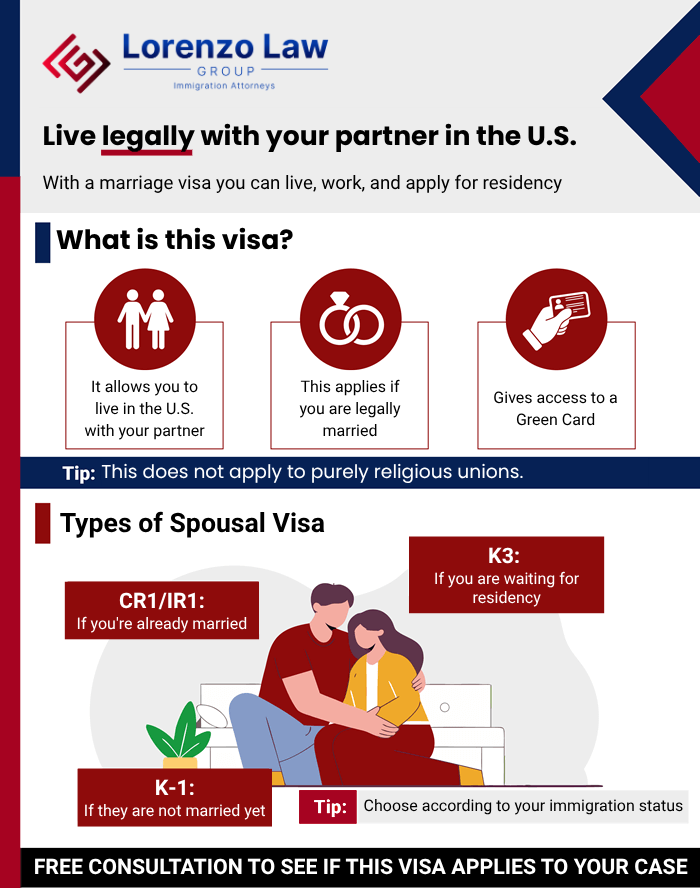
For spouses of U.S. citizens who have been married for less than 2 years when the spouse becomes a permanent resident. CR1 generally applies through consular processing, while CR6 applies through adjustment of status in the United States. The residence is conditional for 2 years.
For spouses of U.S. citizens who have been married for at least 2 years when permanent residence is granted. IR1 generally applies through consular processing, while IR6 applies through adjustment of status.
For spouses of lawful permanent residents, also known as green card holders. Unlike spouses of U.S. citizens in the immediate relative category, F2A applicants are subject to annual visa limits and may need to wait for a visa to become available. If the marriage is less than 2 years old when the spouse becomes a permanent resident, the residence is conditional for 2 years.
For spouses of U.S. citizens who have a pending Form I-130 petition. The K-3 is a temporary visa intended to allow the foreign spouse to come to the United States while the immigrant visa process is pending. K-3 visas are now uncommon because the I-130 is often processed before the K-3 process can be completed.
IR1, CR1, and F2A are immigrant spouse visas that lead to permanent resident status when the spouse is admitted to the United States. A K-3 is temporary and requires an additional step to obtain permanent residence.
Requirements for a Marriage Visa in the United States
Applying for a marriage visa in the United States requires meeting certain requirements. These may vary slightly depending on your situation, but here are the most important ones:
- Be legally married to a U.S. citizen or permanent resident. The marriage generally must be legally valid where it took place and recognized for U.S. immigration purposes.
- The marriage must be genuine and in good faith, not solely for immigration purposes.
- The government may request evidence such as photos, text messages, shared accounts, or travel together.
- The citizen or permanent resident must file a petition (Form I-130) with USCIS.
- The petitioner must demonstrate sufficient income to support their spouse or provide a financial sponsor.
Common Documents Required:
- Official marriage certificate.
- Copies of passports and identification.
- Proof of relationship (photos, letters, shared accounts, etc.).
- Birth certificates.
- Criminal background check, if applicable.
- Proof of immigration status of the citizen or resident.
Speak With an Immigration Attorney Today
What Is the Process for Obtaining a Marriage Visa?
The process of obtaining a marriage visa in the United States may seem lengthy, but if you know the steps and have legal support, it’s much simpler. Here’s how it works:
1. Initial Petition (Form I-130)
The first step is taken by the citizen or permanent resident. They must file a family-based petition with USCIS using Form I-130.
This form tells the government: “I am legally married and want to bring my spouse to live with me.”
Evidence of the marriage and the authenticity of the relationship is included.
2. Case Review
USCIS reviews the petition and supporting evidence. If the petition is approved, what happens next depends on whether the spouse will apply from outside the United States through consular processing or apply for adjustment of status from within the United States.
Approval of Form I-130 does not by itself grant a visa or permanent residence.
3. Consular Process or Adjustment of Status
For spouses of lawful permanent residents in the F2A category, a visa must be available before permanent residence can be granted. Visa availability is based on the applicant’s priority date and the monthly Visa Bulletin.
If the spouse is outside the U.S., the approved petition is generally sent to the National Visa Center (NVC). The NVC handles the next stages of consular processing, including fees and documents, before an interview is scheduled at a U.S. embassy or consulate. For F2A cases, an interview cannot be scheduled unless a visa is available.
If the spouse is eligible to adjust status from within the U.S., the permanent residence application is handled by USCIS rather than the NVC.
4. Medical Examination and Documents
The spouse must undergo a medical examination. For consular processing, the medical exam must be completed by an approved panel physician. Adjustment-of-status applicants generally use a USCIS-designated civil surgeon. They must also prepare documents such as:
- Original birth certificates.
- Valid passport.
- Proof of relationship to the petitioner.
- Evidence of the sponsor’s financial resources.
5. Interview
The final part of the process is the immigration interview. Here, the officer verifies that the marriage is legitimate and that all documents are complete. They may ask personal questions about the relationship. It’s important to be well-prepared and honest.
How Long Does the Marriage Visa Application Process Take?
The processing time for a marriage visa can vary significantly. There is no single, exact timeframe that applies to all cases.
Factors that influence processing time include:
- Petitioner’s immigration status: If your spouse is a U.S. citizen, the process is usually faster than if they are a permanent resident.
- Location where the process is initiated: It’s not the same if your spouse is in the United States and adjusting their status, as opposed to if they live in another country and are waiting for their consular appointment.
- Workload of immigration offices: Sometimes USCIS, embassies, or consulates have a large backlog of cases, which can cause delays.
- Incomplete documentation or errors: If information is missing, there are errors, or the marriage proof is not presented correctly, the process can be lengthy.
Interview or additional review: In some cases, immigration officials request more evidence or a second interview. This can also affect processing times.
How to Get a Faster Marriage Visa Processing Time
Not all delays are preventable, but couples can do their part by submitting consistent forms and complete documentation from the very beginning instead of waiting for USCIS to request more information. Information about addresses, employment, previous marriages, children, travel, and immigration history must match across all forms. Foreign language records should be accompanied by English translations that meet all government requirements.
Your evidence of a good faith marriage should reflect a couple’s actual life together. Every marriage is different, so it’s important to use evidence that actually shows what your marriage is like, rather than trying to match what you think an immigration agency wants to see. Helpful evidence may include shared housing records, insurance policies, joint financial accounts, travel records, photographs, correspondence, and evidence of regular and affectionate contact during periods of separation. You don’t want to overwhelm immigration officials with repetitive material that doesn’t show them anything new about your marriage; you want to present organized evidence that demonstrates the validity of your marriage.
With the help of a marriage visa attorney, you can catch inconsistencies early in the process. They can also help suggest evidence that may prove the validity of your marriage, help you prepare for your interview, and respond to requests for information.
How a Marriage Visa Lawyer Can Help Prevent Delays
The marriage visa process involves multiple government agencies, complex forms, and supporting documents. An application that seems straightforward can be complicated by a spouse with a complex immigration history, prior visa denial, criminal record, previous marriage, or insufficient financial sponsorship. Working with a marriage visa lawyer ensures that you discover these issues before they lead to avoidable delays or denials.
A marriage visa attorney can also help a couple determine whether adjustment of status or consular processing is the best option for them. The right option depends on more than just where your spouse currently lives. An experienced marriage visa lawyer knows to look at potential issues that could affect the application, such as the spouse’s manner of entry, current immigration classification, past periods of unlawful presence, and immigration court history.
Can My Foreign Partner Work While on a Marriage Visa?
It depends on the type of visa your partner has and the stage of the immigration process.
If your partner is outside the U.S.:
- Upon entering with a marriage visa (CR1 or IR1), your partner receives permanent residency (Green Card).
- This allows them to work legally from the first day they arrive in the country.
- They do not need to apply for additional permission.
If your partner is already in the U.S. and is applying for adjustment of status:
- They can apply for a work permit (Form I-765) while waiting for their residency approval.
- The permit is issued separately and is what allows them to work legally.
- Until they receive it, they cannot work legally.
Important: Working without authorization can cause problems in the immigration process. It is always best to wait for official authorization.
You Don’t Have to Handle This Alone
Limitations of a Marriage Visa
While a marriage visa offers many benefits, it also has certain limitations that are important to be aware of. Being well-informed helps you avoid mistakes that could affect your immigration status or that of your spouse.
These are some of the main limitations:
- Real commitment.The relationship must be genuine. The government can investigate and even conduct personal interviews to confirm that the marriage is not for show.
- Economic dependence on the sponsor.The petitioner (citizen or resident) must legally commit to supporting their partner if necessary. This involves signing a financial agreement with the government.
- Travel restrictions.If your partner is adjusting their status within the U.S., they should avoid leaving the country without special permission, as they could lose their application.
- It doesn’t protect against everything.Having a spousal visa does not immediately protect your partner from other complicated immigration situations, such as old deportation orders or previous illegal entries.
What Happens After Obtaining the Visa?
If your partner entered the country with a CR1, IR1 or F2A visa, they will receive their green card by mail after arriving in the United States. In these cases, no further paperwork is required within the country.
If your partner is already in the U.S. and is adjusting their status, the application for permanent residency is submitted from here, along with other forms such as the work permit.
Conditional or Permanent Residence
If they have been married for less than two years, their residency will be conditional for two years. Before that time expires, they must complete another process to remove the conditions and demonstrate that the marriage is still valid.
If they have been married for more than two years when the case is approved, they will be granted direct permanent residency, valid for 10 years.
After Obtaining a Green Card, Your Partner Can:
- Work legally.
- Travel abroad with greater peace of mind.
- Apply for U.S. citizenship after meeting the required residency requirements.
Tips to Reduce the Margin of Error When Applying for a Marriage Visa
We know the marriage visa process can seem complicated and emotionally draining. But with good preparation and guidance, you can avoid common mistakes and move forward with greater peace of mind.
Here are some practical tips:
Before Starting the Application
- Ensure you have a legally valid marriage. The marriage certificate must be registered and in good standing.
- Gather real evidence of the relationship. This is key to proving that it is not a marriage for show.
- Verify your financial eligibility. If the petitioner does not have sufficient income, they can use a joint sponsor.
When Submitting the Application
- Fill out all forms carefully. Double-check that nothing is missing and that the information matches on all documents.
- Translate all documents in other languages into English. Translations must be complete and certified.
- Submit the entire application package. If anything is missing, USCIS may delay your case or request additional information later.
During the Process
- Keep copies of everything you send. It’s important to have a backup in case they request it later.
- Respond promptly to any requests from USCIS or the consulate. If they ask for additional documents or evidence, submit everything within the deadline.
- Prepare well for the interview. Study important dates together, how you met, and real details of your relationship. It’s not about memorizing answers, but about telling your story honestly.

Do You Need Help with Your Marriage Visa?
A marriage visa in the United States is much more than a legal procedure: it’s the gateway to a shared life, free from distance and uncertainty. While the process may seem complex, with a service like ours, we can help you avoid mistakes and move forward with confidence.
Remember that every story is unique. What matters is that you and your partner are well-informed, prepared, and supported every step of the way. Ready to begin this new chapter? Contact us today. Love shouldn’t have to wait any longer.

1 Ring
Average time it takes us to answer your call.

3 Minutes
Approximate time needed to let you know if we can review your case.