

Approved asylum cases in the United States represent hope and legal protection for thousands of people fleeing persecution, violence, or serious threats in their home countries.
Although theAsylum cases can save the lives of those who apply, obtaining an approval is not automatic or easy, especially in 2026, when the immigration system faces high levels of applications, historical backlogs, and stricter evaluation criteria.
For many asylum seekers, understanding how the processes work and what mistakes to avoid can make the difference between legal protection or a deportation and return order.
Why are approved asylum cases in the United States important?
In the United States, an approved asylum case occurs when the government determines that a person meets the legal definition of a refugee under the Immigration and Nationality Act (INA).
A person meets the requirements when he or she demonstrates past persecution or a credible fear of future persecution on the basis of political opinion, nationality, ethnicity, religion, or membership in a particular social group.
When a case is approved, the person obtains asylee status, work permit, and, after one year of being granted asylum, can apply for lawful permanent residence. Therefore, understanding what leads to approval is essential for those seeking protection.
Types of Asylum Cases Approved in the USA
Asylum cases approved in the United States can be resolved in two ways: through the affirmative process before USCIS or in a defensive process before an immigration judge. In both scenarios, the burden of proof is on the applicant, who must present clear, consistent, and credible evidence.
What is an affirmative asylum case before USCIS?
An affirmative asylum case before USCIS occurs when a person applies for asylum voluntarily, without being in removal proceedings before an immigration court.
The affirmative asylum application is submitted to the U.S. Citizenship and Immigration Services (USCIS) using Form I-589, as long as the person is physically in the country.
In the affirmative asylum process, USCIS reviews the application, analyzes the evidence submitted, and schedules an interview with a trained asylum officer. During this interview, you should clearly explain why you are afraid to return to your country and how that fear relates to persecution for reasons protected by law, such as:
- Political opinion.
- Religion.
- Nationality.
- Breed.
- Belonging to a particular social group.
A key point of affirmative asylum is that it is not a punitive process, but an administrative evaluation.
Therefore, if the officer considers that your case meets the legal requirements, your application may result in one of the approved cases, which gives you immediate legal protection, authorization to work, and the possibility of applying for permanent residence after one year.
However, if USCIS does not approve the case and the person does not have other valid immigration status, the file is usually sent to the immigration court to initiate a defensive process. For this reason, correctly preparing an affirmative asylum case is essential, since mistakes at this stage can seriously complicate the migratory future.
What is defensive asylum in the United States?
Defensive asylum is the type of asylum application that is filed when a person is already in removal proceedings before an immigration court. Unlike affirmative asylum, this procedure occurs in front of an immigration judge and not directly before USCIS.
This process can begin in two main ways:
- When USCIS denies an affirmative asylum application and sends the case to immigration court for review by a judge.
- When a person is apprehended by immigration authorities, either when trying to enter the country through a port of entry, by the Border Patrol, or by U.S. Immigration and Customs Enforcement (ICE), and requests asylum as a way to avoid deportation.
During defensive asylum, the judge evaluates the evidence, hears the applicant’s testimony, and considers any objections raised by the government attorney.
This process can include several hearings and, in many cases, takes months or even years due to the workload of the immigration courts.
According to data from TRAC Immigration, 2,271,857 immigrants who applied for asylum were awaiting their hearing in August 2025.
Although the defense process can be more complex and stressful, there are also approved cases in the United States that are resolved favorably before a judge.
However, in both cases, the applicant must defend their right to remain in the United States by demonstrating that they meet the legal requirements to receive protection as an asylee.
Given the current political landscape, it is essential that people who are eligible for asylum do not wait until the last minute to start their process. If you believe that you or a loved one may apply for asylum, call us at Lorenzo Law Group for a fully confidential consultation in Spanish.
Immigration and Asylum Projections in 2026
The year 2026 is particularly important due to recent changes in immigration policies, backlog of pending cases, and variations in approval rates.
According to data from TRAC Immigration, the immigration court system has more than 3.6 million pending cases, of which more than 2 million correspond to asylum applications.
Between January and August 2025, immigration judges ordered the deportation of 470,213 immigrants, which represented 54.9% of the total immigration cases processed during that period.
Specifically, in August 2025 alone, denied asylum applications exceeded 77%, reflecting a high rejection rate in asylum cases approved by 2025.
These figures highlight the need for the legal support of a team of immigration lawyers with experience in asylum cases, especially in the context of increasingly restrictive immigration policies.
Overview of U.S. Asylum Approvals in 2026
The outlook for approved asylum cases in the US in 2026 is not encouraging, as the US government’s policies are openly anti-immigrant and have limited access to asylum claims for many people.
Even with the tightening of migration and asylum policies, it is essential to know where it is convenient to file the asylum application. For example, in San Francisco, during 2024, there were immigration judges who rejected 91.6% of asylum cases, while others only rejected 1.3%.
In asylum cases, it is not only essential to know the law; it is necessary to know the Executive Office for Immigration Review (EOIR) and the particularities of the judges.
At Lorenzo Law Group/Immigration Lawyers we have practical experience in different counties and before various immigration judges, which allows us to understand how the criteria and dynamics can vary depending on the jurisdiction.
This experience has helped us to better guide the legal strategies of each case, always keeping in mind that each situation is unique and that the results depend on multiple factors.
To increase the chance of receiving the letter of approved asylum cases, it is necessary to present a strong case, with adequate representation in a favorable county.
What factors increase the odds of an approved asylum case?
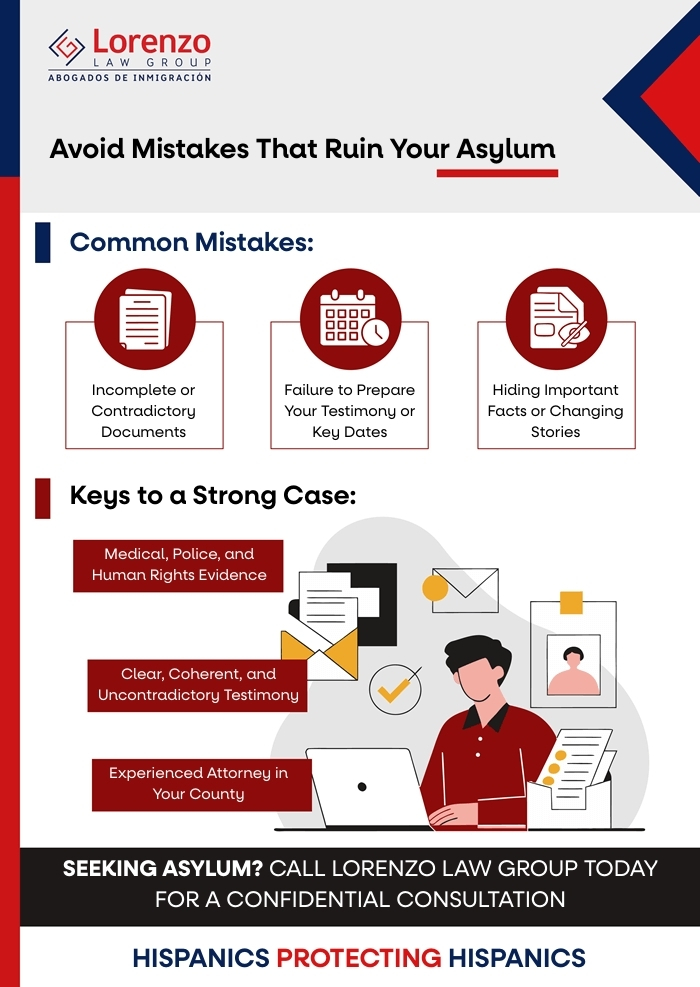
One of the most important factors in approved political asylum cases is the quality of the evidence presented. USCIS and immigration judges evaluate documents such as police reports, medical reports, affidavits and reports from human rights organizations that support the fear of persecution.
The applicant’s testimony must also be coherent and consistent. UNHCR‘s Handbook on the Protection of Stateless Persons states that significant contradictions can seriously affect credibility, even when the person suffered actual persecution.
Some of the contradictions that may affect your asylum case are:
- Changes on key dates.
- Variations in the scene of the events.
- Different stories between forms and interviews.
- Omission of relevant facts in initial statements.
- Changes in the main reason for asylum.
- Inconsistencies with information from the country of origin.
- Differences between testimony and documentary evidence.
- Inconsistent versions of political or social participation.
- Unclear explanations about exits and entries to the country.
- Conflicting accounts of future threats.
Another key factor is legal representation. People with lawyers have significantly higher odds of success compared to those who face the process alone. The adequate preparation for the interview or hearing is decisive.
Common Mistakes That Lead to Asylum Denials
Many cases fail due to avoidable errors, some of the most frequent are:
- Submitting incomplete or inconsistent documentation. A significant proportion of denials occur when essential evidence is missing or there are contradictions between forms and testimonies.
- Lack of preparation for the asylum interview. Not knowing your own file, not remembering key dates, or not clearly explaining the facts can affect the perception of credibility.
- Omitting relevant information. Although some people are afraid to tell certain details, hiding important facts can be interpreted as dishonesty and closing the door to future resources.
Approved Asylum Cases, Examples
There are certain cases in which the approval has been satisfactory, for example:
- Requests from people who fled threats from criminal groups after denouncing corruption.
- Journalists persecuted for their political opinion.
- Women who escaped extreme violence when their government failed to offer protection.
In others, the key was to present medical documents, police reports, expert statements and coherent testimony.
Having the support of a nonprofit, human rights organization, or immigration lawyers can increase the credibility of cases.
How to Prepare a Strong Asylum Case in 2026
To begin, preparing a strong case starts with Form I-589, which must be completed accurately and honestly. USCIS highlights that errors on this form can affect the entire process.
It is also essential to organize supporting evidence and prepare your testimony in advance. UNHCR recommends that the narrative of events be practised in chronological order and clearly.
In this context, having reliable legal advice allows you to identify weaknesses, strengthen evidence, and adequately answer difficult questions during interviews or hearings.
In fact, in an increasingly demanding system, having the legal advice of successful attorneys committed to the immigrant community is essential.
In conclusion, approved asylum cases do not depend on luck, but on preparation, solid evidence, and proper advice. If you think you can file an asylum case, call us for a confidential consultation. Learn about all your options and next steps.
If you were interested in this article, we also recommend: