

If you are wondering after the work permit how long residency takes, you are not alone.
Many Latino migrants experience anxiety and uncertainty while waiting for their green card , especially as they face the varying USCIS (United States Citizenship and Immigration Services) times and complex legal paperwork.
In fact, according to USCIS data, processing times for permanent residency applications can vary significantly depending on the visa category and the office handling the case.
For example, for those applying for residency under the abuse category (U visa), the average time from receipt of the petition to issuance of the EAD (Employment Authorization Document) is approximately 48.2 months.
Faced with this reality, it is essential to understand the factors that can speed up or delay the process, as well as the steps you can take while you wait for your residency.
In our blog Lorenzo Law Group/Immigration Lawyers, we explain how long it takes for the green card to arrive, what influences wait times and how to plan each stage of your process safely.
How long does it take for residency with EAD to arrive?
The U.S. work permit, officially called EAD, allows migrants with certain statuses to work legally in the United States. Obtaining it is an important step, but it does not guarantee permanent residency or a specific time frame for it.
According to USCIS, more than 1.5 million EADs are issued each year, including U visa holders (victims of certain crimes), asylum seekers, and people with pending adjustment of status.
Having the EAD allows you to generate legal income and demonstrate stability, key factors in residency applications.
Let’s look at a practical example
Maria is an immigrant of Mexican descent, she obtained her EAD after a year of waiting while her U visa case was pending. Although you can now work, your permanent residency still requires USCIS to approve your adjustment of status.
How long does it take for the green card to arrive after paying?
According to Pew Research Center, approximately 700,000 adjustment of status applications were processed in 2022, with significant variations between visa types.
The waiting time depends on the type of visa and the status of the application:
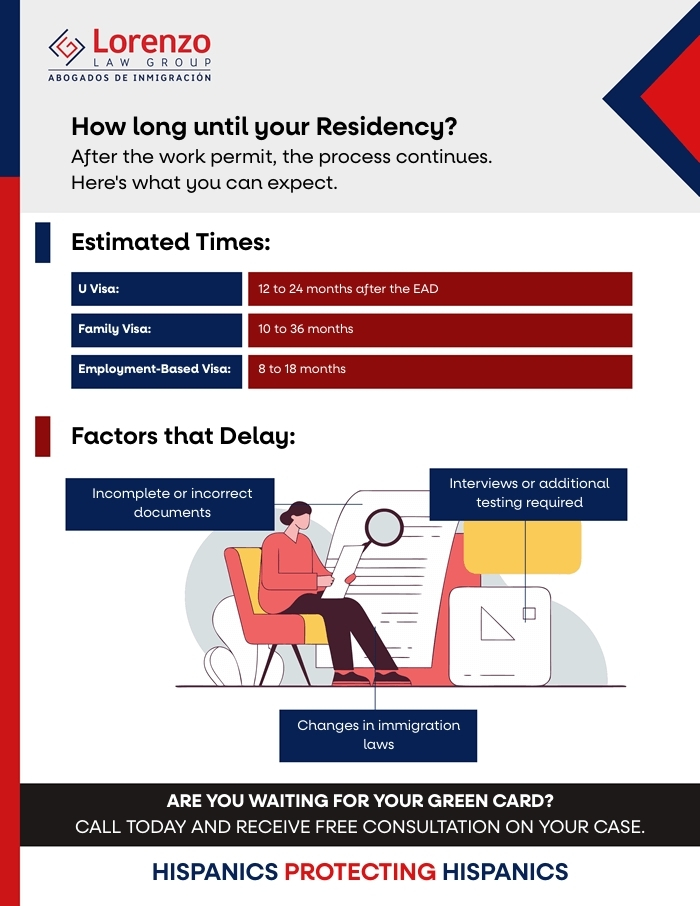
- U visa (victims of criminal acts): adjustment of status can take anywhere from 12 to 24 months after receiving the work permit;
- Family visa: between 10 and 36 months, depending on the family relationship and the availability of places;
- Employment-based visa: usually between 8 and 18 months, but can vary depending on the country of origin;
How long does it take for U.S. residency to arrive?
The time it takes for U.S. residency to arrive depends on factors such as:
- The visa category you have;
- The availability of quotas according to the country of origin;
- The completeness and correctness of the documentation submitted;
- The USCIS workload at the field office.
In 2023, USCIS reported that average times for adjustment of status cases were between 14 and 28 months, depending on the category and state where the application was filed.
How long does U visa residency take?
After obtaining the EAD, holders can apply for permanent residency. The U visa is granted to victims of certain crimes who cooperate with the authorities and the times may vary:
- The average process is 12 to 24 months from the approval of the EAD.
- The time may lengthen if USCIS requires additional evidence or conducts additional interviews.
According to USCIS, “EAD approval does not guarantee immediate residency, but it does allow the applicant to work and live legally while their adjustment of status is processed.”
Hypothetical case
Jose is an immigrant from Honduras who asked how long it takes to residency by U visa, since he obtained his EAD after 8 months of waiting. However, her application for said residency is still pending and USCIS notified her that the estimated approval time is 18 months.
What factors can delay the green card after the work permit?
Several factors can lengthen the waiting time:
- Incomplete or incorrect documentation: Forms with errors or missing evidence may result in requests for additional evidence (Request for Evidence).
- Interviews and background checks: USCIS conducts security and criminal background checks.
- Administrative delays: depending on the volume of applications in the field office.
- Changes in immigration policies: New regulations may affect processing times.
These factors show that the waiting time for the green card after the work permit can vary considerably.
Being prepared, filing complete paperwork, and staying informed about changes in immigration policies can help reduce delays and make the process easier.
What to do while waiting for my residency after the work permit?
While you’re waiting for your green card, there are several important actions that can help you maintain your legal status and make the process easier:
- Keep personal and contact information with USCIS up to date: It is critical that USCIS has your correct address, email, and phone number to avoid delays in important notifications;
- Avoid employment changes that may affect your visa status: Although the EAD allows you to work legally, some changes may influence eligibility for adjustment of status depending on the type of visa you have;
- Document all payments and receipts related to your application: Keeping evidence of fee payments, legal services, or translations can be helpful if USCIS requests clarifications or additional evidence;
- Comply with all legal and renewal obligations: Applying to renew your EAD before it expires and complying with any travel requirements (Advance Parole) helps maintain your active status without interruption;
- Consult with a specialized attorney to anticipate problems: An immigration attorney can review your case, alert you to potential delays, requests for additional evidence, and other critical steps that need to be taken while you wait.
Contacting an immigration attorney to monitor your case and receive guidance on safe and legal steps can help you reach your immigration goals more easily.
What rights do I have while I am waiting for residency?
Even if you have EADs:
- The right to work legally in the U.S.;
- Right to renew EAD before expiration;
- The right to travel under certain conditions (Advance Parole);
- Protection from deportation while adjustment of status is pending.
According to USCIS, more than 85% of EAD renewals are approved within 90 days of application, as long as the requirements are met.
How long does residency take for other types of visas?
- Direct Family Visa: 10 to 36 months.
- Employment-based visa: 8 to 18 months, depending on country of origin.
- Asylum: 12 to 24 months from EAD approval, but can vary.
Regularly check the U.S. Department of State’s Visa Bulletin for date availability and to plan your application.
Plan your future: after the work permit, how long does it take for residency to arrive
Knowing after the work permit, how long it takes to residency is essential to organize your life in the United States.
Although times may vary depending on the visa category, country of origin, and the accuracy of the documentation submitted, understanding these factors allows you to anticipate potential delays and make informed decisions about employment, studies, and family planning.
The wait time for a green card after obtaining a work permit can be long, but being informed and prepared makes all the difference. With a clear strategy, you can reduce risks, maintain your job stability, and ensure that your immigration process runs its course safely.
At Lorenzo Law Group/Immigration Attorneys, we understand the anxiety and uncertainty immigrants feel when waiting for their permanent residency.
Our team offers personalized advice at every stage of the process, from obtaining an EAD to green card approval, helping you understand your rights and make informed decisions to protect your immigration status.
If you want personalized guidance on your case and how long it takes for a green card to arrive, contact us today and receive a free consultation on how long residency takes after the work permit.