
Family-Based Immigration Lawyers in Virginia, Maryland & D.C.
Do you want to legally reunite with your family in the U.S.A.? Family-Based Immigration Lawyers in Virginia, Maryland & D.C might be the option for you. A family-based immigration petition is the legal path to help close relatives of permanent residents or citizens obtain permanent residency and a stable legal status in the U.S.
Everyone at Lorenzo Law Group / Immigration Lawyers is an immigrant or has immigrant family members. That is why we understand how crucial it is to keep families together.
Our experienced family-based immigration lawyers have lived through the process themselves and have helped multiple families reunite.
We will guide you step by step through your application process. Starting with a thorough review of your case, we evaluate your options and help you fill out the I-130 form to ensure your application is handled correctly from the very start.
You don’t need to know all the immigration laws yourself; that’s our job. What matters most is knowing that the right lawyers are working on your case.
What is Family Based Immigration?
Family-Based Immigration is the legal process through which U.S. citizens and permanent residents can help their relatives live and work legally in the United States.
Filing the I-130 lets U.S. Citizenship and Immigration Services (USCIS) know that a valid family relationship exists between you and the relative you want to sponsor. It’s the first step toward a Green Card and, ultimately, permanent legal status.
Not everyone qualifies, but if you do, a family-based immigration petition opens the door for your loved one to:
- Live legally in the U.S.
- Work legally with proper authorization.
- Access certain immigration benefits.
- Begin the pathway toward permanent residency and, in some cases, citizenship.
At Lorenzo Law Group / Immigration Lawyers, our family-based immigration attorneys will carefully review your relationship, explain who can benefit, and guide you through every step of the petition process. You don’t have to navigate this alone; we’ve been through it, and we know what works.
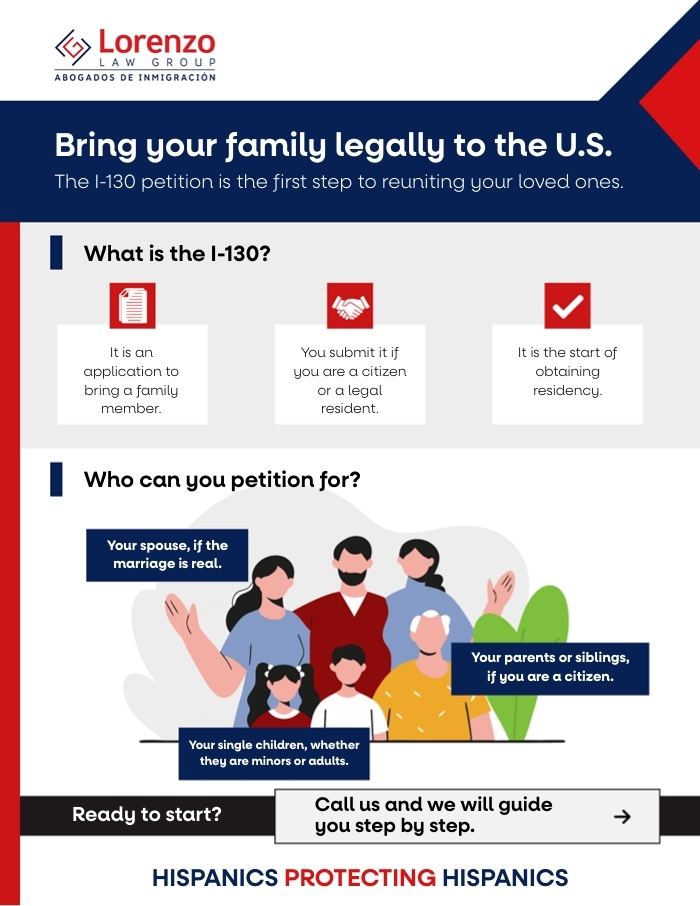
Who Can Apply for U.S. Residency Through Family-Based Immigration
Family-Based Immigration allows certain relatives of U.S. citizens or lawful permanent residents to obtain a Green Card and live legally in the United States. Not every relationship qualifies, but when it does, filing the I-130 Petition is the first and most important step in bringing your loved one closer to permanent residency.
If you are a U.S. citizen, you can petition for:
- Your spouse: the marriage must be legally valid and genuine. It doesn't matter if your spouse is currently living inside or outside the United States.
- Your unmarried children under 21: stepchildren may also qualify if the marriage to their parent took place before the child turned 18.
- Your unmarried sons or daughters over 21
- Your married sons or daughters of any age: the process to petition married sons and daughters takes longer than that of unmarried ones.
- Your parents: you must be at least 21 years old to petition for your parents.
- Your brothers or sisters: you must also be 21 or older to file for your siblings.
If you are a lawful permanent resident (Green Card holder), you can petition for:
- Your spouse: This is one of the most common ways to obtain a Green Card through family ties.
- Your unmarried children: Whether they are under or over 21, they must be single to qualify.
Each of these family categories falls under specific immigration preference groups, and the waiting times vary depending on the relationship and visa availability.
At Lorenzo Law Group / Immigration Lawyers, our family-based immigration attorneys can help determine how to best position your case for success. We take the time to understand your family’s story and guide you through every requirement, so you can bring your loved ones home legally, safely, and with peace of mind.
Who Is Not Eligible to File Form I-130?
Helping a loved one obtain lawful residency through Family-Based Immigration is a dream for many families. However, not every relationship or circumstance qualifies under U.S. immigration law. The I-130 petition is a powerful legal tool, but it has strict eligibility rules that must be met before filing.
Here’s a clear breakdown of who cannot be included in a family-based immigration petition:
Relationships not recognized by U.S. immigration law, such as:
- Close friends or romantic partners without a legal marriage.
- Godparents, cousins, or other extended family members not covered by the law.
Invalid family relationships under immigration law, such as:
- Marriages that were only celebrated for immigration or other legal purposes.
- Marriages that were annulled or ended before filing the petition.
- Adoptions that were finalized after the child turned 16, or that do not meet the required legal process.
Petitioners without eligible immigration status:
- Permanent residents cannot petition for siblings; only U.S. citizens can.
- Only U.S. citizens or lawful permanent residents can submit Form I-130.
Relationships that do not meet the required age conditions, such as:
- You must be at least 21 years old to petition for your parents.
You don’t meet all the required criteria?
We can explore other options for your legal migration. Immigration law is complex, but there are often alternative routes depending on your circumstances. At Lorenzo Law Group / Immigration Lawyers, a family-based immigration lawyer can evaluate your case, explain your options clearly, and help you find the best legal path for you and your loved ones.
Can I Work While My I-130 Petition Is Being Processed?
Filing a Family-Based Immigration petition (Form I-130) is only the first step toward helping your loved one obtain lawful permanent residency in the United States. However, the process can be lengthy, especially for parents and married children. That’s why one of the most common questions we hear from clients is:
“Can I work while my I-130 is still pending?”
The answer to this question depends on your particular case. However, the work permit is not granted automatically, you have to apply.
If You Are Inside the United States:
You can only work legally if you have a valid work permit. Submitting Form I-130 alone does not authorize you to work.
However, in some cases, you may apply for a work permit while your green card application is being processed. You can apply for a work permit when:
- You file Form I-130 together with Form I-485 (Adjustment of Status).
- You are already in the U.S. and meet the eligibility to adjust your status.
- You comply with all other immigration requirements.
If you meet these conditions, you can file Form I-765 to request a temporary work authorization (Employment Authorization Document, EAD) while your case moves forward. This document allows you to legally work, support your family, and gain peace of mind during the waiting period.
If You Are Outside the United States:
If your immigration process is handled through a U.S. consulate or embassy abroad, you will need to wait until your immigrant visa is approved, and you receive your residency approval before you can legally work in the United States.
During this phase, you must remain in your home country while your case is reviewed and approved.
How Does Family-Based Immigration Work?
Family-Based Immigration follows a clear but detailed process that unfolds in several stages. The very first step is to submit Form I-130, also known as the Petition for Alien Relative. However, that’s only the beginning.
Every case is unique, but here’s an overview of how family-based immigration works:
Step 1: File the I-130 Petition
If you are a U.S. citizen or lawful permanent resident, you’ll begin by filing Form I-130 with USCIS (U.S. Citizenship and Immigration Services). This document officially notifies the government that you have a qualifying family relationship with the person you wish to bring to the United States.
- If the petition is approved, that means the USCIS recognizes that family connection.
- That approval does not mean your loved one has received a Green Card yet; it simply means the process can move forward to the next stage.
Step 2: Wait for a Visa to Become Available
- If your relative is considered an immediate relative, such as a spouse, parent, or unmarried child under 21 of a U.S. citizen, a visa is immediately issued with no waiting period.For all other relatives, such as married children, siblings of U.S. citizens, or children of lawful permanent residents, the process depends on the Visa Bulletin published each month by the U.S. Department of State. These cases may involve a waiting period that varies from months to several years.
Step 3: Choose the Right Processing Path
The next step depends on where your family member currently lives:
- If your relative is in the U.S. they can usually apply for Adjustment of Status by filing Form I-485. This allows them to request permanent residency without leaving the country.
- If your relative is outside the U.S. the process goes through Consular Processing. Once a visa is available, your relative will attend an interview at the U.S. Embassy or Consulate in their home country.
Step 4: The Interview and Final Decision
In both Adjustment of Status and Consular Processing, your relative will be required to attend an immigration interview. During this step, the government reviews the documents, verifies the relationship, and confirms that the applicant is eligible for permanent residency.
If everything is in order, the residency or visa is approved and issued, allowing your family member to live and work legally in the United States.
How Long Does Family Based Immigration Take?
One of the most common questions we hear from our clients is: “How long does family-based immigration take?” The truth is, there isn’t a single answer that fits everyone.
The processing time for Family-Based Immigration can vary widely depending on several factors; including your relationship with the family member, your immigration status, and whether your relative is applying from inside or outside the United States.
Here are the main factors that influence how long family-based immigration takes:
Immediate relatives of U.S. citizens, such as spouses, unmarried children under 21, and parents, usually have the fastest processing times. Once the I-130 Petition for Alien Relative is approved, they can move directly to the next stage since visas for these categories are always available.
The average processing time is around 6 to 12 months for the I-130 approval, followed by the next phase of adjustment or consular processing.
However, other relatives, like siblings, married children, or relatives of lawful permanent residents, fall into different categories, which might be subject to annual visa limits. Depending on demand and visa availability, these cases may take several years to move forward.
The estimated wait times for other relatives are between 2 and 10 years or more, depending on the category and country of origin.
If your family member is already in the country and qualifies for an Adjustment of Status, the process tends to be more efficient since they can apply for the Green Card without leaving the U.S.
If the family members you are petitioning for are living abroad, they must go through Consular Processing. This process can add several additional months to the overall waiting time.
Unfortunately, delays at USCIS or the National Visa Center are common. Changes in immigration policy or visa quotas can also affect how quickly your case moves forward. That’s why having a family-based immigration attorney overseeing your case is crucial to avoid unnecessary delays.
At Lorenzo Law Group / Immigration Lawyers, our family-based immigration lawyers track every update in your case and handle communication with immigration authorities to ensure that your petition moves as smoothly and quickly as possible.
Even though Family-Based Immigration can take time, we make sure every step brings you closer to what truly matters: being reunited with your loved ones and securing a stable future together in the United States.
Why a Successful Family Based Immigration Attorney Is Your Greatest Ally
Navigating Family-Based Immigration can feel overwhelming, the process is complex, lengthy, and full of details that are easy to miss. That’s why having an experienced Family Based Immigration Lawyer by your side makes all the difference.
At Lorenzo Law Group / Immigration Lawyers, we understand how important it is for you to reunite your family, achieve stability, and live with peace of mind in the United States.
Here’s how we support you every step of the way:
We Guide You With Clarity
Our team explains how family-based immigration works in plain language. From the initial I-130 petition to supporting documents and application timelines, we walk you through each step so you know exactly what to expect.
We Prevent Costly Mistakes
Even a small error on the I-130 form, or missing a filing deadline, can delay your case by months or years. Our family-based immigration attorneys carefully review your application and documents to ensure everything is accurate and complete before submission.
We Support You If Issues Arise
Some cases are more complicated than others; prior immigration violations, denied petitions, or unusual circumstances may require strategic intervention. We act as your legal backup, protecting your rights and advocating for your family at every stage.
We Keep You Informed Throughout
We know how important peace of mind is during the immigration process. That’s why we maintain clear, ongoing communication. Whether your case involves adjustment of status inside the U.S. or consular processing abroad, you’ll always know where your petition stands.
With a trusted family-based immigration lawyer on your team, you’re never facing this journey alone. At Lorenzo Law Group / Immigration Lawyers, we combine legal expertise, personal experience, and empathy to make Family-Based Immigration as smooth and predictable as possible.
Do You Want To Help A Family Member Migrate Or Adjust Their Status? Contact Us!
Starting a Family-Based Immigration petition can feel complicated, but you don’t have to do it alone. With the right guidance, the process can be clearer, faster, and much more secure.
At Lorenzo Law Group / Immigration Lawyers, we are here to support you from the very first form to the moment your loved one receives their Green Card through Family-Based Immigration. Whether you are just beginning the process or have questions about an ongoing case, we are ready to listen, guide, and fight for you every step of the way.
Reuniting your family is possible, and with an experienced family-based immigration attorney by your side, you’ll have the confidence and legal support you need to navigate each step. At Lorenzo Law Group, we are Hispanics protecting Hispanics.
Contact us today and let our skilled family-based immigration lawyers in Virginia, Maryland & D.C. develop a personalized strategy for your case. Together, we can make your family’s reunion a reality.