
Work Permits
Work permits in the United States are the key to unlocking legal, secure employment with benefits. If you’re an immigrant in the Virginia, Maryland, and Washington, D.C. area and are looking for ways to start working smoothly, this guide is for you.
Here, we explain everything you need to know in simple terms: from how to apply for a work visa to the most common mistakes to avoid. Whether you need a temporary permit, a skills-based visa, or are awaiting immigration adjustment, Lorenzo Law Group / Immigration Attorneys is here to help you every step of the way.
What are work permits needed for?
If you are not a U.S. citizen or permanent resident, you need a work permit to work legally. This document is issued by U.S. Citizenship and Immigration Services (USCIS) and authorizes you to accept employment in the United States.
With a work permit, you can:
- Obtain employment legally anywhere in the U.S.
- Apply for a Social Security number if you don't have one.
- Access to employment benefits such as fair wages, protection against abuse, and opportunities for advancement.
- Feeling at ease knowing that you are complying with the law.
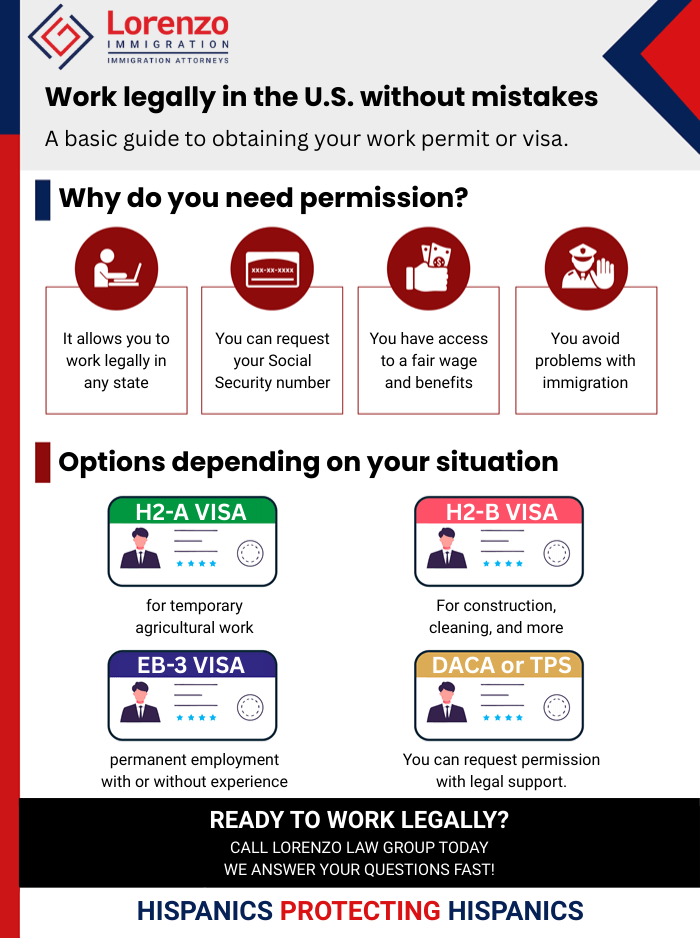
A work permit in the United States is key if you are in the immigration process, such as:
- You requested asylum and you still haven't received a response
- You are in the process of adjusting your status.
- You have a temporary work visa.
- You are a beneficiary of Consideration of Deferred Action for Childhood Arrivals (DACA), Temporary Protected Status (TPS) in the middle of the program.
If you want to apply for a work visa for the United States or have already started your immigration process, an immigration lawyer can help you apply for your work permit with USCIS without errors or delays.
Learn about the most common work permits and visas
There are different ways to work legally in the United States, depending on your immigration status. For example, some people can work with a temporary work permit, while others arrive in the country with approved work visas. There are also those who obtain permanent employment-based visas, known as Green Cards.
Here we explain the most common ones:
Work Visas (Nonimmigrant)
These visas are temporary. They allow you to work for a limited time, usually for a specific employer. If you change jobs or the visa expires, you need to renew or change your status.
Some of the most common ones are:

H-1B
Workers in specialized occupations such as technology, medicine, and engineering.
H-1B
H-2A
H-2B
Non-agricultural jobs can be in construction, cleaning, tourism, among others.
H-2B
L-1
Employees transferred within the same international company.
L-1
O-1
People with extraordinary abilities, usually in areas such as art, science, or sports.
O-1
TN
Citizens of Mexico or Canada under the free trade agreement (USMCA).
TN
These visas do not always include a work permit issued by USCIS because the right to work is already implied in the visa, but they must remain valid so that you can continue your professional activity legally.
Permanent Work Visas (Immigrant)
Also known as EB (Employment-Based) visas, these allow you to live and work permanently in the U.S. They are a pathway to permanent residency.
The main categories are:
EB-1
People with extraordinary skills, outstanding teachers, or multinational executives.
EB-1
EB-2
Professionals with advanced degrees or exceptional skills.
EB-2
EB-3
Skilled, professional or unskilled workers (e.g., jobs with labor shortages).
EB-3
EB-4
Religious workers and other special categories.
EB-4
EB-5
Investors who create jobs in the U.S.
EB-5
With these visas, you can work legally anywhere in the country without needing to renew temporary permits.

Your story deserves to be heard. In Virginia, Maryland, and Washington, D.C., Lorenzo Law Group provides clear, confidential immigration guidance at every stage of the process. Our team is committed to listening, responding, and helping you move forward with confidence.
How to apply for a work visa for the United States?
Applying for a U.S. work visa isn’t the same for everyone. The process depends on your visa type, your country of origin, and whether you’re already in or outside the country.
Generally, these are the most common steps:
- 1 To get a job offer from a company in the United States.
- 2 Make sure this company can sponsor your visa.
- 3 Submit the application to the Department of Labor or USCIS, depending on the type of visa.
- 4 Wait for approval and, if you are outside the country, schedule your appointment at the embassy or consulate.
But each visa has specific requirements. Below, we explain how the process works depending on the type of visa or work permit you need.
- Many U.S. work visas require an employer to initiate the process. This is called employment sponsorship. This means that you, as the applicant, cannot apply for the visa on your own. The company submits the application to the government.
Some of the most common visas that require sponsorship are:
- H-1B: professionals with university degrees.
- H-2A and H-2B: temporary agricultural or non-agricultural workers.
- L-1: intra-company transfers.
- EB-2 and EB-3: employment-based permanent visas.
What can you do as an applicant? Although the employer handles the application, you can still take action:
- Look for employers willing to sponsor foreign workers.
- Prepare your resume and gather your credentials or degrees.
Keep your passport and personal documents up to date. - Make sure you meet the job requirements.
It’s also a good idea to speak with an immigration attorney who can help you identify opportunities and determine if you qualify for a work visa with sponsorship.
Important: If the employer is unfamiliar with the process, an attorney can guide them to ensure the sponsorship is done correctly.
If you have a distinguished career or have achieved international recognition in your field, you may be eligible to apply for a U.S. work visa without sponsorship.
These types of visas are designed for individuals with extraordinary abilities in areas such as:
- Science
- Education
- Business
- Sports
- Arts
Most common visas in this category:
- O-1: for individuals with verifiable extraordinary achievements. For example: international awards, publications, jury service, etc.
- EB-1: for those seeking permanent residency who meet similar criteria, such as:
- Receiving relevant awards.
- Author of significant research or publications.
- Having outstanding work experience or leadership positions.
What can you do?
- Gather evidence of your achievements: awards, articles, interviews, letters of recommendation, etc.
- Prepare a professional portfolio that demonstrates your impact in your industry.
- Contact an attorney to help you present a strong case.
In these cases, you can file the application directly with USCIS. You don’t need a company to sponsor you, but you do need to demonstrate that your work has national or international value.
If you are already in the United States and have an immigration process underway, you may be able to apply for a work permit while you await your immigration status. This permit is officially known as an Employment Authorization Document (EAD) and is requested from USCIS.
This type of permit is not a visa, but it allows you to work legally while your case is pending.
Who can apply for this permit?
- People who have applied for asylum or refugee status.
- Those who are in the process of adjusting their status (for example, through marriage to a U.S. citizen).
- Beneficiaries of programs such as:
- DACA
- TPS (Temporary Protected Status)
- VAWA (for domestic violence)
- People with applications for cancellation of removal or in immigration proceedings.
What can you do?
- Consult with an attorney to find out if you qualify.
- File Form I-765 with USCIS with the assistance of a professional.
- Gather your identification documents and proof of your ongoing immigration process.
Be aware of deadlines and renewals.
This type of work permit in the United States provides peace of mind while your immigration status is being resolved. You don’t need a prior job offer; you simply need to demonstrate that you qualify under one of the permitted categories.
Why do I need the support of a lawyer to apply for a work permit in the United States?
We know your goal is to work legally and build a better future. But the U.S. immigration system can be confusing, slow, and full of technicalities. A small mistake can delay your case for months… or worse, get it denied.
An immigration attorney is here to help, protect, and guide you every step of the way.
Why is legal support so important?
- They help you fill out the forms correctly and avoid rejections due to errors.
- They know what documents you need and when you should send them.
- They evaluate your case and tell you if you qualify for a work permit, visa, or adjustment of status.
- They explain what type of work visa or permit is best for you based on your plans.
- If your case is complicated, they are prepared to represent you before USCIS or a judge.

Furthermore, if your employer is unsure how to sponsor you, our attorney can guide them and facilitate the process.
At Lorenzo Law Group / Immigration Attorneys, we speak frankly, without beating around the bush or making empty promises. We carefully review your situation and find the best way to help you work legally in the United States as soon as possible.
You are not alone. We help you get closer to that goal: obtaining your work permit and starting your journey with peace of mind.
Common mistakes when trying to obtain visas and work permits
When it comes to working legally in the United States, many people make mistakes that could be avoided with the right information and support. Some of these mistakes can delay your application, cause rejections, or even affect future applications.
Here are some of the most common mistakes so you can avoid them from the start:
Avoiding these mistakes is key to a smooth process. If you plan to apply for a work visa or work permit in the United States, get the right guidance from the start.
Hispanic lawyers helping Hispanics in the United States: Lorenzo Law Group / Immigration Attorneys!
Work permits represent much more than the possibility of earning an income; they mean stability, protection, and the opportunity to build a more secure life in the United States. But to achieve this without mistakes or delays, you need clear information and reliable legal support.
At Lorenzo Law Group / Immigration Attorneys, we understand how valuable this step is for you and your family. Our team is ready to help you apply for your work permit or employment visa with confidence, clarity, and the support of experienced immigration attorneys.
Do you want to work legally in the United States with a work permit? Start today. Schedule your consultation, trust our award-winning service, and let us help you achieve your goal.