


DACA (Deferred Action for Childhood Arrivals) protects certain people who came to the United States as children from deportation and lets them request a work permit. Below, we answer the most common questions with official information from USCIS: whether you can still apply or renew in 2026, what happens if your DACA expires, and whether DACA can lead to a green card or citizenship.
DACA 2026 update: can I still apply or renew?
If you are looking for DACA news in 2026, here is the official status. After the U.S. Court of Appeals for the Fifth Circuit decision of January 17, 2025, USCIS:
- Accepts and processes DACA renewal requests and the related work permits.
- Accepts new DACA applications (initial requests) but is not processing them at this time.
- Keeps current DACA grants and work permits valid until they expire, unless they are individually terminated.
The court case behind these rules comes from DACA in Texas: a July 16, 2021, injunction from the U.S. District Court for the Southern District of Texas, affirmed by the Fifth Circuit, prohibits DHS from granting initial DACA requests and related work permits.
Source: USCIS, DACA page (updated January 24, 2025). Accessed November 18, 2026.
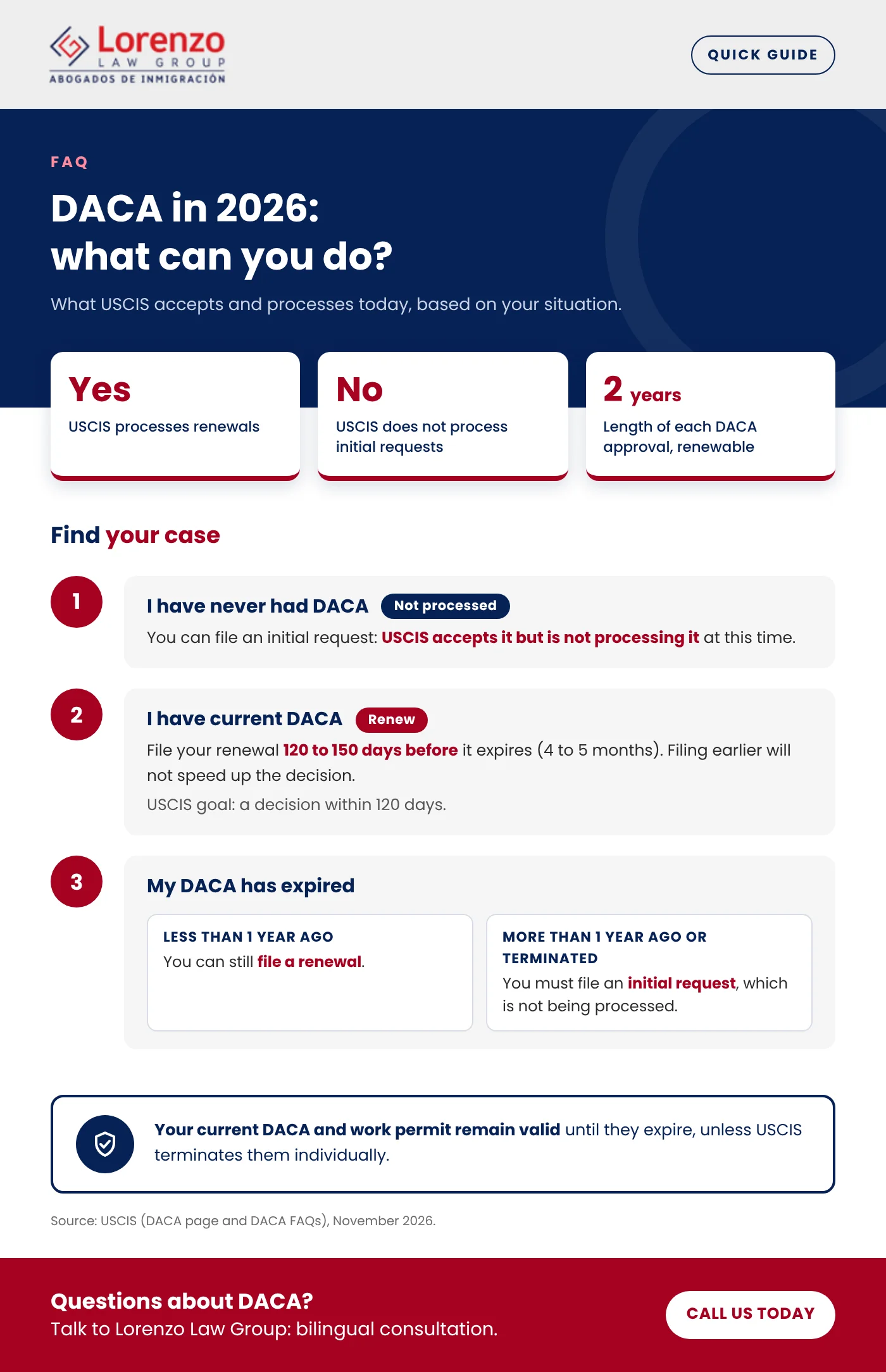
DACA in 2026: what you can do, based on your situation. Source: USCIS, November 2026.
DACA renewal requirements
- You did not travel outside the United States on or after August 15, 2012, without advance parole.
- You have lived continuously in the United States since your most recent approved DACA request.
- You have not been convicted of a felony, a significant misdemeanor, or three or more other misdemeanors, and you are not a threat to national security or public safety.
You do not need to still be in school to renew. You can also renew if you are now 31 or older, as long as you were under 31 on June 15, 2012.
How to file a DACA renewal in 2026
- When: file 120 to 150 days (4 to 5 months) before the expiration date on your Form I-797 approval notice and work permit. Filing earlier will not get you a faster decision.
- What: Form I-821D, Form I-765, and the I-765WS worksheet, by mail or online through a USCIS online account. Only send new documents if you have removal proceedings or criminal history you have not already submitted.
- Fees: filed by mail, a DACA request costs $605 in total: $85 for Form I-821D and $520 for Form I-765. Form I-765 costs $470 if filed online, according to the USCIS fee schedule (Form G-1055). There are no fee waivers for DACA, only very limited fee exemptions.
- Status: check your USCIS DACA status online with your receipt number or your USCIS online account. USCIS aims to decide renewals within 120 days, and you can submit an online inquiry once your request has been pending more than 105 days.
Source: USCIS fee schedule (Form G-1055, updated October 28, 2026) and DACA page. Accessed November 18, 2026.
Can I travel with DACA? (advance parole)
Not automatically. After USCIS approves your DACA, you can request advance parole with Form I-131. USCIS generally grants it only for humanitarian, educational, or employment purposes; vacation does not qualify. Leaving the United States without advance parole carries a significant risk of not being able to return.
On travel with advance parole: under a 2026 Board of Immigration Appeals (BIA) decision, leaving the United States on advance parole counts as a “departure” for the 10-year unlawful presence bar (Matter of Delcarmen-Lara, 29 I&N Dec. 830). If you were unlawfully present in the United States for one year or more, traveling, even with advance parole, could trigger it. Talk to an attorney before you travel.
Source: Board of Immigration Appeals (BIA), Matter of Delcarmen-Lara, 29 I&N Dec. 830 (2026), precedent decisions, U.S. Department of Justice (EOIR). Accessed November 20, 2026.
What happens if my DACA expires before renewal?
- If it expired less than one year ago, you can still file a renewal request.
- If it expired more than one year ago, or if your DACA was terminated, you must file a new initial request, which USCIS is not processing at this time.
- If your DACA expires before your renewal is approved, you are not authorized to work until you receive a new work permit, regardless of your age. You also accrue unlawful presence for the gap, unless you were under 18 when you filed the renewal.
That is why, if your DACA is expiring, USCIS strongly encourages filing within the 120- to 150-day window. See the USCIS DACA FAQs for details.
Source: USCIS DACA FAQs (updated October 30, 2025).
Can DACA recipients become U.S. citizens?
Can a DACA recipient apply for citizenship through DACA? No. According to USCIS, deferred action does not provide a path to permanent residence (a green card) or to citizenship; only Congress can grant those rights.
However, DACA recipients can become permanent residents if they qualify under an existing immigration pathway. According to DHS data cited by the Congressional Research Service, 133,930 DACA recipients had become permanent residents as of March 31, 2024, and 93% did so through family-based immigration.
Can a DACA recipient get a green card by marrying a U.S. citizen?
Marriage to a U.S. citizen is one of the existing pathways. The spouse of a U.S. citizen is an immediate relative, and an immigrant visa is always available in that category. Form I-130 and the green card application (Form I-485) can be filed together, according to the USCIS immediate relative green card page.
To apply for a green card from inside the United States (adjustment of status), USCIS generally requires that you were inspected and admitted or inspected and paroled when you entered, with some limited exceptions. People outside the United States apply through consular processing.
Whether a DACA recipient married to a U.S. citizen can adjust status depends on how they entered the country and their immigration history. Our adjustment of status attorneys can review your case before you file.
What is a Dreamer in immigration?
A Dreamer is a person in the United States who came to the country as a child and does not have lawful immigration status. DACA recipients are a subset of Dreamers: those who meet the DACA requirements and were granted DACA.
The DREAM Act (Development, Relief, and Education for Alien Minors Act) was introduced in the Senate in 2001 to offer permanent residence to certain people who came as children, but it never became law. Similar bills, generally known as “Dream Act” bills, have been introduced since; as of June 2025, none had been enacted.
Talk to an immigration attorney
Lorenzo Law Group can review whether you can renew DACA, whether you qualify for a green card through another pathway, and the risks of traveling. Schedule a consultation.
This article is for informational purposes and does not constitute legal advice. Every case is different.