
If you were abused by your U.S. citizen or permanent resident spouse (or former spouse) or parent, or by your U.S. citizen son or daughter who is 21 or older, a VAWA visa may let you apply for a green card on your own, without depending on that person. Below, we answer the most common questions about how it works, how long it takes, and what comes next.
To see whether you qualify, review the requirements on our VAWA immigration attorney page or contact us for a confidential evaluation.
What is a VAWA visa and how does it work?
A VAWA visa is not a visa in the strict sense. It is a self-petition that lets survivors of abuse apply for permanent residence on their own. The name comes from the Violence Against Women Act, but it protects people of any gender.
Here is how it works:
- You file Form I-360 with USCIS, without the abuser signing it, knowing about it, or taking part.
- You prove your family relationship with the U.S. citizen or permanent resident and the abuse or extreme cruelty you suffered.
- If USCIS approves the petition, you can move forward with your green card application.
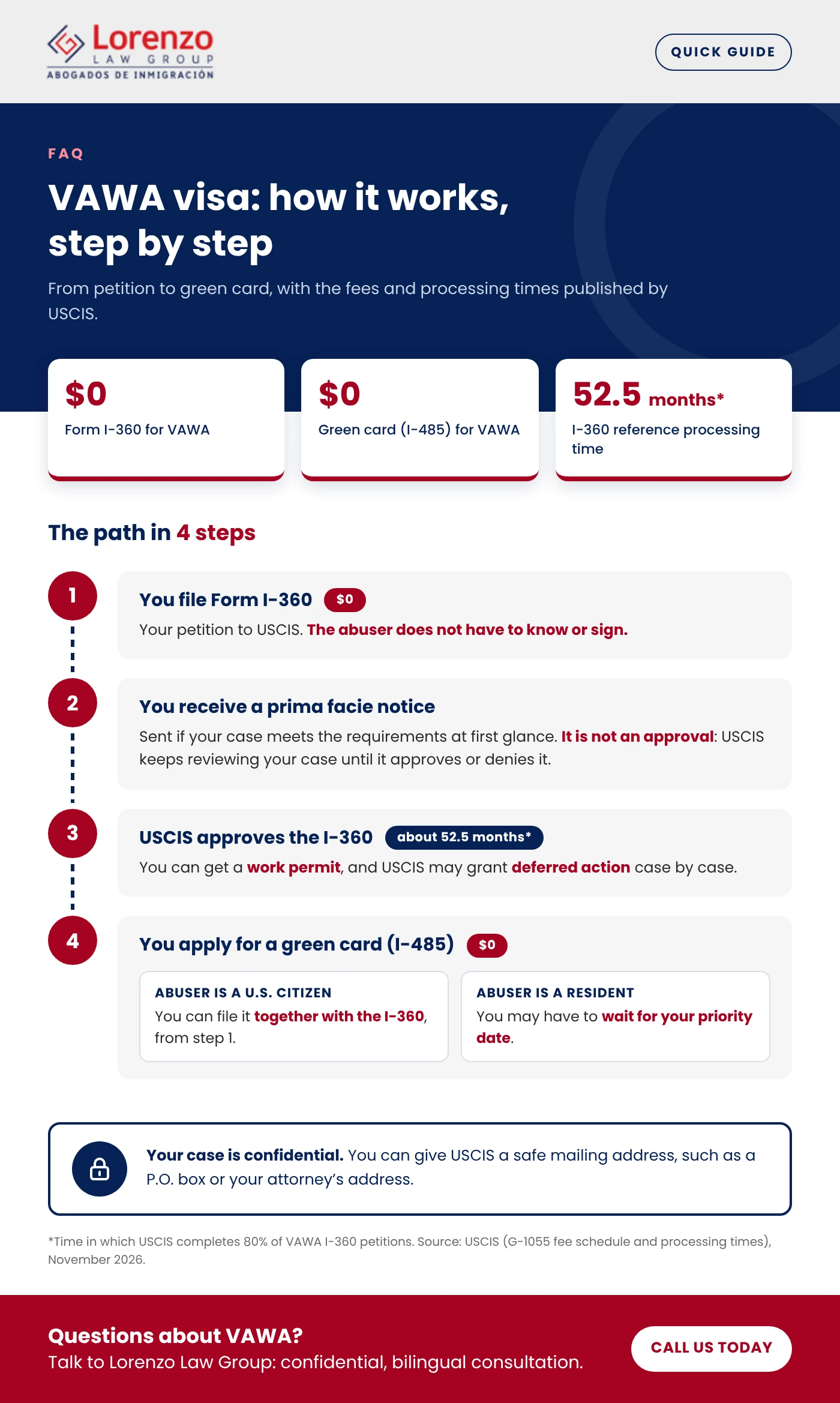
VAWA visa process infographic in 4 steps: Form I-360, prima facie notice, approval and green card (I-485).
Your case is confidential by law: USCIS can share information about it only in very limited circumstances. You can also give USCIS a safe mailing address, such as a P.O. box or your attorney’s address, even if you do not live there.
What is the VAWA processing time?
According to USCIS processing times checked in November 2026, USCIS completes 80% of VAWA I-360 petitions within about 52.5 months (more than four years). This is a reference point for how long VAWA takes to be approved: some cases are decided sooner and others take longer.
Then comes the green card. If the abuser is a U.S. citizen, you can apply right away, even at the same time as the I-360. If the abuser is a permanent resident, you may have to wait until your priority date is current in the category for spouses and children of permanent residents (F2A). Those dates change every month, and you can check them in the State Department’s Visa Bulletin. That is why the total time depends on each case.
What is a VAWA RFE and what evidence helps?
A VAWA RFE (Request for Evidence) is a notice USCIS sends when it needs more proof before deciding your case. It explains what is missing and gives you a deadline: up to 12 weeks (plus 3 days if the notice is mailed), although the officer can set a shorter one, and USCIS cannot extend it. If you do not respond by the deadline, USCIS may deny your case as abandoned, based on the evidence it already has, or for both reasons. If you send only part of what USCIS asked for, USCIS treats your response as a request to decide the case, so answer everything at once. USCIS can also deny a case without sending an RFE first if required initial evidence is missing, so it is best to submit complete evidence from the start.
Since December 22, 2025, USCIS applies updated guidance to VAWA self-petitions, including cases that were already pending. Among other changes:
- You must show that you lived with the abuser during the qualifying relationship (for example, during the marriage). Before, having lived together at some point in the past was enough.
- If you file as a spouse, USCIS now asks for primary evidence of the marriage, such as a valid marriage certificate, proof that any prior marriages ended, and evidence that the relationship was genuine. It still considers any credible evidence, but including these documents from the start can help you avoid an RFE.
- USCIS alone decides which evidence is credible and how much weight to give it.
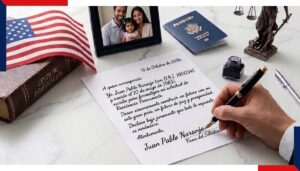
Helpful evidence can include your personal statement, messages, photos, medical or counseling records, proof that you lived together, and witness letters from people who know about the relationship or the abuse. A police report is not required: USCIS will consider any relevant, credible evidence. Statements and letters need details: USCIS still considers vague affidavits, but may give them little weight. There is no official template or “winning” submission: what matters is that the evidence covers each requirement and is specific and consistent. If you received an RFE, our VAWA attorneys can help you respond.
What happens after the I-360 is approved?
The Form I-360 is the petition used to request VAWA protection. There is no fee for VAWA self-petitioners: the general fee is $515, but VAWA filers do not pay it, according to the USCIS fee schedule (Form G-1055).
Once your I-360 is approved, what comes next is:
- Applying for a VAWA green card through adjustment of status (Form I-485), if you have not already. VAWA self-petitioners do not pay this fee either: the general fee is $1,440 on paper or $1,390 online.
- Protection while you wait: if you are in the United States, USCIS may consider you for deferred action on a case-by-case basis. An approved I-360 does not give you immigration status by itself; it is the step that lets you apply for a green card.
- A VAWA work permit: if your I-360 is approved and you live in the United States, you can get work authorization. You can request your first work permit on the I-360 itself by checking the box; if you did not, you file Form I-765 after approval. If you already applied for a green card (I-485), you can also apply based on that pending application.
- Including your children: if you file as a spouse or child, your unmarried children under 21 can be included in your petition and, once it is approved, can also apply for a green card and a work permit. Parents of a U.S. citizen son or daughter cannot include children.
Two more things to know. When you file, USCIS sends a prima facie notice (Notice of Prima Facie Case) if your case meets the requirements at first glance. It is not an approval: USCIS keeps reviewing your case until it approves or denies it. Spouses and children (not parents) can use this notice for some public benefits, but a 2025 federal law (Pub. L. 119-21) excluded VAWA self-petitioners who are not permanent residents from SNAP (food stamps) and, starting October 1, 2026, from federally funded Medicaid and CHIP, ith limited exceptions such as emergency care. Before applying for public assistance, check which programs apply in your state.
And when you apply for a green card, VAWA self-petitioners are exempt from the public charge and entry-without-inspection grounds of inadmissibility. Other grounds, such as certain criminal records, still apply, and some can be forgiven with immigration waivers.
What happens to the abuser in a VAWA case?
The VAWA case itself does not punish the abuser: it is an immigration petition that only decides whether you qualify. You file it without the abuser’s knowledge, consent, or participation in the process, and federal law (8 U.S.C. § 1367) protects the confidentiality of your case.
If you want to report the abuse or seek protection, such as a protective order, that is a separate legal process through the police or the courts. If you already have a protective order, include a copy with your petition: USCIS strongly encourages it.
Does VAWA apply to men or emotional abuse?
Yes. VAWA for men works the same as for women: the law protects anyone abused by a U.S. citizen or permanent resident spouse, former spouse, or parent, or by a U.S. citizen son or daughter who is 21 or older, regardless of gender. You can also file as a spouse if your spouse abused your child.
Abuse does not have to be physical. The law includes extreme cruelty: psychological abuse (often called emotional abuse) and threats of violence count, and other behavior, such as isolation or financial control, can also count when it is part of an overall pattern of abuse.
Keep in mind that since December 2025, USCIS has been reviewing VAWA petitions more closely after a sharp rise in filings, including from men and parents. The requirements did not change, but solid, consistent evidence matters more than ever.
Is there an interview for a VAWA green card?
USCIS may call you for an interview to review both your I-360 petition and your green card application. Being called does not mean there is a problem with your case, and no rule guarantees a VAWA green card without an interview.
The notice goes to your safe address and to your attorney. The interview takes place at the USCIS field office that serves the area where you live, with officers trained in trauma-informed interviewing and confidentiality protections. If you cannot attend, ask USCIS to reschedule before the appointment time. If you miss it without doing so, USCIS may deny both the petition and the green card application.
Can I travel while my VAWA case is pending?
Only with an advance parole document. Advance parole is still available for VAWA self-petitioners with a pending green card application (I-485): you request it with Form I-131 before you travel. If you leave the United States without it, USCIS will deny your green card application, except in narrow cases involving certain nonimmigrant statuses.
Even with advance parole, reentry is not guaranteed: a U.S. Customs and Border Protection (CBP) officer at the airport or border makes the final decision. And since August 13, 2026, a trip on advance parole counts as a “departure” for the unlawful presence bars (Matter of Delcarmen-Lara, 29 I&N Dec. 830). If you were in the United States without legal status for a year or more, leaving, even with advance parole, could trigger a 10-year bar to returning. If your situation is different, for example an approved I-360 without a green card application, the rules depend on your case. Talk to an attorney before making any travel plans.
If you are in danger or need immediate support, call the National Domestic Violence Hotline at 800-799-7233 (TTY: 800-787-3224).
Talk to a VAWA lawyer
Every VAWA case is different, and gathering evidence without putting yourself at risk takes care. At Lorenzo Law Group, we review your case confidentially, in English and Spanish. Learn how we work as VAWA immigration attorneys or schedule your consultation.
If you were the victim of a crime in the United States but have no family relationship with the abuser, another option may be the U visa.
This article is for informational purposes only and does not constitute legal advice. Every case is different.