

Adjustment of Status
Adjustment of Status allows you to obtain permanent residency without leaving the U.S., while learning the requirements, steps, and how a lawyer can help you achieve it successfully.
An adjustment of status is your potential pathway to a Green Card without leaving the United States, but when do you truly need a dedicated legal team to guide you?
If you are living in the U.S. and dream of building your future here on a legal footing, you have likely heard of this process. It allows individuals already within the country to change their immigration standing, transforming uncertainty into secure, permanent residency.
Whether you are here because of marriage, a job offer, or another qualifying circumstance, navigating the USCIS adjustment of status process is the critical step toward obtaining your Green Card and the peace of mind that comes with it.
At Lorenzo Law Group, we believe that adjusting your status to secure your future in this country should be a transparent process without legal complications. Our mission is to help you understand your options and accompany you on this journey, because the law, at its best, is a shield for those who have hope.
Table of Contents
Talk To An Immigration Attorney Who Understands Your Story.
What’s the adjustment of status?
In the complex architecture of American immigration law, an adjustment of status is a profound legal mechanism. It is the formal process that allows an individual already physically present in the United States to apply for Lawful Permanent Resident status (a Green Card) without having to return to their home country for consular processing.
Think of it not merely as a change in paperwork, but as a transition in standing. For example, someone who entered with a tourist visa (B-2) may seek to remain as a student or to build a life with their U.S. citizen spouse. This process allows for that change from within U.S. borders, preventing the often painful and risky separation of families.
What are the different types of status changes?
The law provides for several avenues, including:
- Changing from a tourist visa to a student visa.
- Transitioning from a temporary work visa to permanent residency (green card).
- Moving from a fiancé(e) visa (K-1) to a permanent resident after marriage.
- Adjusting from various other non-immigrant statuses to immigrant status.
What do you need to start?
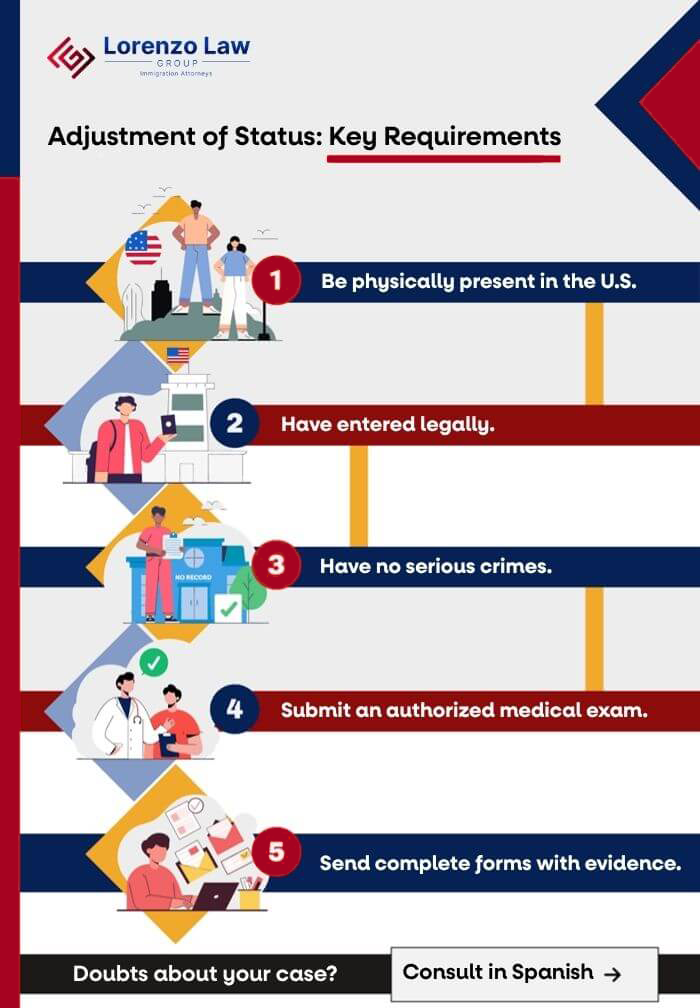
To be eligible for this process, you must generally meet several key requirements:
- Be physically present in the United States.
- Have been admitted or paroled into the U.S. legally.
- Have a valid, approved immigrant petition (such as a family-based or employment-based petition).
- Have an immigrant visa immediately available to you.
- Be admissible to the United States.
This pathway stands in contrast to applying for an immigrant visa from abroad. Here, you are seeking a change without leaving the country. In many cases, those who qualify for an adjustment of status can also obtain benefits like a work license while their application is pending, allowing them to provide for their families as they wait.
What are the common grounds for filing an adjustment of status?
The adjustment of status process is a privileged one, not available to all. It is typically reserved for those who find themselves in specific, legally recognized situations. Understanding which category you fall into is the first step in determining your eligibility.
1. Marriage to a U.S. citizen or Lawful permanent resident
This is one of the most common. If you married a U.S. citizen, you may file for an adjustment of status after marriage. You can also concurrently apply for a work permit to legally support yourself and your family during the process.
2. Approved family-based petition
Children, parents, or siblings of U.S. citizens or permanent residents may adjust their status if they are already in the U.S. and have an approved Form I-130 petition.
3. Employment-based petition
Individuals with a qualifying job offer from a U.S. employer may be eligible for an employment-based adjustment of status. The process is typically initiated by the employer.
4. Asylum or refugee status
If you have been granted asylum or entered as a refugee, you become eligible to apply for a Green Card after one year in the United States.
5. Victims of violence or crime
Individuals protected under the Violence Against Women Act (VAWA) or those holding a U or T visa (for victims of crime or trafficking) may qualify for an adjustment of status.
6. Diversity visa lottery
If you are a winner of the diversity visa lottery and are already in the U.S. legally, you may be able to adjust your status from within the country.
7. Other special programs
Including individuals with Temporary Protected Status (TPS), certain DACA recipients under specific circumstances, and those eligible under laws like NACARA relief.
In addition, you will need to pass a medical exam, pay the corresponding fees (we’ll talk about the status adjustment price later) and submit all the necessary forms.
Key requirements for an adjustment of status
Filing for an adjustment of status is more than an expression of desire to stay; it is a formal petition scrutinized by the government.
Meeting the following requirements is not just helpful, it´s imperative.
Physical presence in the U.S.
You cannot file from abroad.
Legal entry
Most applicants must have been inspected and admitted or paroled into the U.S.
Valid legal basis
Maintained status
Having violated your non-immigrant status (e.g., overstaying or working without authorization) can be a significant barrier, though waivers and exceptions exist.
Admissibility
Certain criminal history, health conditions, or past immigration violations can render a person inadmissible.
Not in removal proceedings
If you are, specific legal strategies must be employed to pursue adjustment.
Furthermore, you will need to complete a medical examination, pay the required adjustment of status fee, and submit all necessary forms accurately and completely.
Speak With an Immigration Attorney Today
Essential documents for an adjustment of status
The documentary evidence required can feel exhaustive, but its purpose is to build an irrefutable case for your eligibility. While your specific situation will dictate the final list, a general framework includes:
Personal identification documents
- Valid passport
- Form I-94 (arrival/departure record) proving legal entry.
- Birth certificate (with certified translation if not in english).
- Government-Issued photo ID (e.g., driver’s license).
Core immigration forms
- Form I-485: The official application to register permanent residence or adjust status.
- Approved Form I-130: for family-based petitions.
- Form I-864: Affidavit of support from your financial sponsor.
- Form I-693: Report of medical examination and vaccination record.
- Form I-765 (optional): Application for employment authorization.
- Form I-131 (optional): Application for a travel document (advance parole).
Relationship evidence (if applicable)
- Marriage certificate, joint bank account statements, leases, insurance policies and photos.
Proof of legal presence
- Copies of your visa and passport entry stamps.
Assembling this dossier is a meticulous task. An error or omission is not merely a delay; it can be a denial. This is where the guidance of a seasoned attorney becomes invaluable, transforming a daunting pile of paperwork into a compelling petition.
Is adjustment of status the same as a work permit?
This is a crucial distinction. They are not the same, but they are intimately connected in practice.
The adjustment of status is the main objective: the legal process to become a lawful permanent resident. The work permit (officially known as an Employment Authorization Document or EAD) is a derivative benefit, a temporary document that grants you the legal ability to work while your primary application is pending.
When you file your USCIS adjustment of status application (Form I-485), you can simultaneously submit Form I-765 to request the work permit. This strategic parallel filing provides a critical lifeline.
Pros of applying for an EAD with your adjustment of status
- Gain the legal right to seek employment.
- Obtain a Social Security Number.
- Apply for a driver’s license in most states.
- Achieve greater financial stability and dignity while awaiting your Green Card.
May I work while I wait for my EAD?
The law is unambiguous on this point: until you physically possess your approved EAD, you cannot work legally in the United States, even if you have filed your adjustment of status application.
We understand the profound difficulty of this waiting period. The need to provide for your family is a powerful and righteous impulse. However, working without authorization carries severe consequences:
- It can jeopardize your entire application for permanent residency.
- It can create a permanent bar to future immigration benefits.
- It can place you into removal proceedings.
What critical points do you need to remember?
- Do not work without authorization: Unauthorized work can be a fatal flaw in an otherwise perfect case.
- Maintain your current status: Until your new status is approved, you must continue to abide by the terms of your original visa.
What does a typical adjustment of status case look like?
The Step-by-Step process:
- You are legally married in the United States.
- Your spouse (the U.S. citizen) files a Form I-130, Petition for Alien Relative, to establish the bona fides of your marriage.
- Concurrently, you file your Form I-485, application for adjustment of status.
- At the same time, you can and should include:
- Form I-765 for your work permit.
- Form I-131 for advance parole (travel permission).
- You attend a biometrics appointment for fingerprinting.
- You and your spouse will later attend an interview with a USCIS officer.
- If all is in order, your residency is approved, and you receive your Green Card.
FAQ about adjustment of status
When can I file for Adjustment of Status after marriage?
You can typically file your application immediately after your marriage, as long as your U.S. citizen spouse has filed or is concurrently filing the Form I-130 petition. This immediate eligibility for an adjustment of status after marriage allows families to begin building their lives together without unnecessary delay.
What happens if my Adjustment of Status application is denied?
A denial means USCIS has found you ineligible for permanent residency. The consequences depend on the reason for denial. You may be placed in removal proceedings. However, you may have options to appeal the decision or file a motion to reopen your case. This is a critical moment where experienced legal counsel is essential to protect your rights.
Can I travel outside the U.S. while my Adjustment of Status is pending?
You must not travel internationally without first obtaining Advance Parole (a travel document) by filing Form I-131. Leaving the U.S. without this document will be considered an abandonment of your application, and you will likely be barred from re-entering. It is a risk not worth taking.
Can I adjust my status if I entered the U.S. without inspection?
Generally, no. If you entered the U.S. without being inspected by an immigration officer (e.g., crossed the border illegally), you are typically barred from adjusting your status. There are very limited exceptions, such as under the provisions of INA 245(i) or for certain applicants eligible for a U visa. This is a complex area of law that requires immediate legal analysis.
Your Path to a New Beginning in the United States
The journey of an adjustment of status is more than a legal procedure; it is the bridge to the future you envision for yourself and your family in this country. While the path can be complex, you do not have to walk it alone.
At Lorenzo Law Group, we understand the profound weight of this step. We are here to demystify the process, prepare your petition with precision, gather the necessary evidence, secure your work permit, and provide clear answers on adjustment of status processing time, fees, and legal requirements.
We are dedicated advocates, bringing not only legal expertise but also cultural understanding and a passionate commitment to your cause.

Start Your Path to Adjustment of Status with Trusted DMV Immigration Lawyers
If you are wondering whether you qualify for adjustment of status, our team is deeply rooted in the community we serve. Take the first step towards a secure future. Schedule a consultation today with our adjustment of status lawyers serving the DMV area. Let us help you build the life you deserve here.

1 Ring
Average time it takes us to answer your call.

3 Minutes
Approximate time needed to let you know if we can review your case.