
K-1 Visa Lawyer
When a relationship crosses borders, the K-1 visa becomes a key option for many engaged couples who want to get married in the United States.
The K-1 visa process often raises a lot of questions, especially about how long it takes, what can be done while it’s pending, and what happens after approval. A K-1 visa lawyer can answer these questions.
Lorenzo Law Group helps U.S. citizens pursue K-1 visas for their foreign fiancés. We recognize that this filing is an important step in building your life together as a married couple. Our K-1 visa lawyer will explain the process, prepare the required petition and supporting evidence, and address issues that may delay your plans. Schedule a consultation with Lorenzo Law Group to discuss your K-1 visa petition and what comes next.
Table of Contents
What is the K-1 Visa?
The fiancé visa, officially known as the K-1 visa, allows a foreign person to enter the United States to marry their U.S. citizen partner.
This visa has a very clear objective: to get married in the United States and then start the process to obtain permanent residency.
In simple terms, the fiancé visa works like this:
- The U.S. citizen petitions for his or her fiancé from the United States.
- The foreign fiancé legally enters the country on a K-1 visa.
- The couple must marry within 90 days of entry.
- After marriage, adjustment of status for residency is requested.
Talk To an Immigration Attorney Who Understands Your Story.
K-1 Visa vs. Marriage Visa: What’s the Difference?
In couple-based immigration processes, there are two main visas that tend to generate confusion: the fiancé visa and the marriage visa. Although both allow couples to live together in the United States, they do not work the same or apply to the same situations.
Fiancé Visa (K-1)
The K-1 visa is for couples who are not yet married and plan to get married in the United States.
Its main characteristics are:
- The petitioner must be a U.S. citizen.
- The couple must prove a genuine relationship and, in most cases, have met in person within the two years before filing.
- The couple must marry within 90 days of entry.
- After marriage, adjustment of status is applied for.
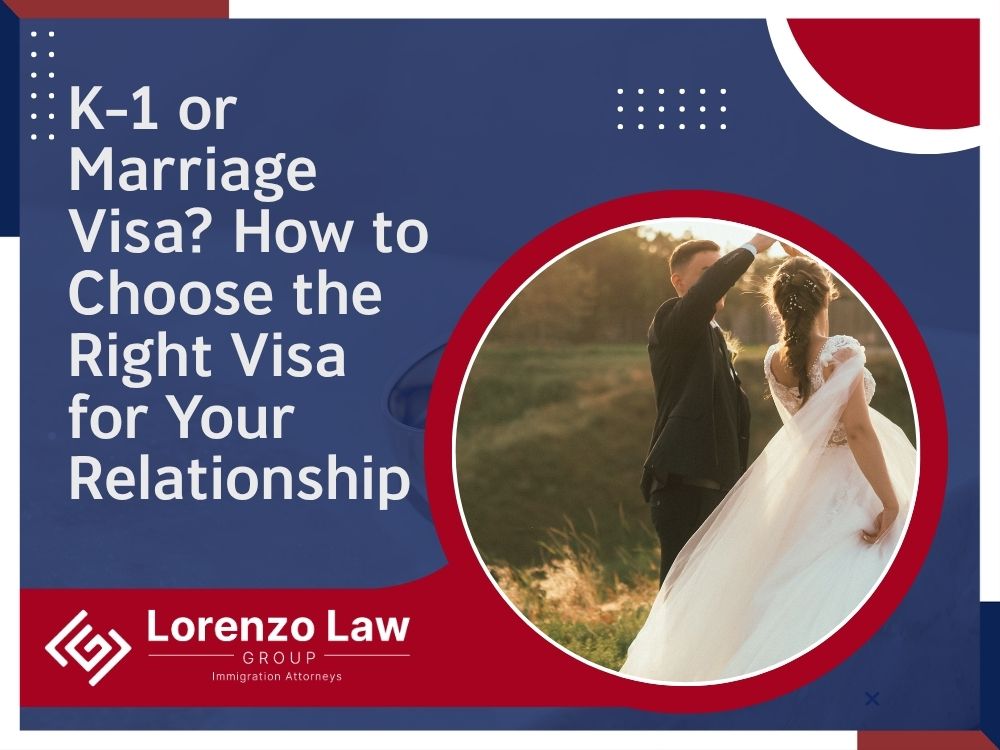
This visa is usually a good option when the couple wants to get married in the United States and start the residency process from here.
Marriage Visa (CR-1 or IR-1)
A marriage visa applies when the couple is already married. There are two types:
- CR-1: For spouses married less than two years when the foreign spouse enters the United States on the immigrant visa.
- IR-1: For spouses married for two years or more when the foreign spouse enters the United States on the immigrant visa.
These visas allow the foreign spouse to enter directly as a permanent resident, without the need to apply for adjustment of status afterward.
When deciding between a K-1 fiancé visa and a marriage-based immigrant visa, consider whether you are already married, when you want to marry, where you want to marry and the immigration steps required after your partner enters the United States. A K-1 visa attorney can review your relationship, preferred timeline, immigration history, and long-term plans before you choose one pathway over the other.
Consult a K-1 Visa Lawyer to Evaluate Your Eligibility
To apply for a K-1 visa, in addition to the relationship, documentation is required. A K-1 visa has specific eligibility and documentation requirements. A K-1 visa lawyer can review whether you meet them and help prepare the required documents.
1. The petitioner must be a U.S. citizen.
Only U.S. citizens can file Form I-129F for a fiancé(e); lawful permanent residents cannot sponsor a fiancé(e) for a K-1 visa.
2. The couple must have the actual intention to get married.
Both partners must show that:
- They have genuine plans for marriage.
- They intend to get married within 90 days of entering the United States.
This intent is proven with signed statements and evidence of the relationship.
3. The couple must have met in person.
In most cases, the law requires that the couple have met at least once in the last two years before applying.
There are only very limited exceptions, for example:
- Meeting in person would violate strict and long-established cultural or social customs.
- Meeting in person would cause extreme hardship to the U.S. citizen petitioner.
These exceptions are not easily granted.
4. Both must be legally available to marry.
This means that:
- Both people must be legally free to marry (no previous marriages in place).
- If there were previous marriages, provide proof that each marriage legally ended, such as a divorce decree, annulment, or death certificate.
USCIS reviews this point very carefully.
5. Both must prove that the relationship is real.
Immigration seeks to confirm that the relationship does not exist only to obtain immigration benefits.
Evidence usually includes:
- Photographs together
- Messages, calls, or emails
- Evidence of mutual support
The quality of the evidence matters more than the quantity.
Before filing, a K-1 visa lawyer can review whether the couple meets each requirement and whether the evidence tells a clear and compelling story of their time together. This review is particularly helpful if the couple:
- Has spent limited time together in person,
- Has a substantial age difference,
- Communicates primarily online,
- Has prior immigration filings,
- Has had visa denials in the past.
USCIS may question these circumstances and ask further questions to verify the legitimacy of the relationship.
Speak With an Immigration Attorney Today
K-1 Visa Interview Questions to Expect
The K-1 visa interview questions you’re asked depend on the evidence you have already submitted and any questions the officer may have. A K-1 visa lawyer can help you prepare to answer questions about:
- Your fiancé’s name and basic information about them
- How you met and what your day-to-day relationship is like (how often you communicate and which methods you use)
- The relationship you have with your fiancé’s family (and vice versa)
- Trips you’ve taken to see each other
How Long Is the K-1 Visa Processing Time?
There is no single K-1 visa processing time; The process occurs in several stages and goes through different agencies.
- First, U.S. Citizenship and Immigration Services (USCIS) reviews the I-129F petition filed by the U.S. citizen. Processing at this stage can take longer if documents are missing, evidence of the relationship is unclear, or USCIS requests additional evidence.
- Once approved, the case goes to the National Visa Center (NVC), which registers it and sends it to the appropriate consulate. The consular interview is scheduled based on the availability of appointments in the applicant’s country.
- Finally, the consulate reviews the case, conducts the interview, and issues the visa if everything is in order. In some cases, an additional administrative review may be required that delays the decision.
After the K-1 visa is approved, the next step is for the foreign fiancé(e) to enter the United States.
Once inside the country, the couple must be married within 90 days; if the marriage does not occur within that timeframe, the person must leave the United States.
After marriage, adjustment of status for permanent residency is requested, during which many couples also apply for a work permit and, if needed, a travel permit. A K-1 visa attorney can also help you prepare to apply for a green card after marriage.
What Are the Fees for a K-1 Visa?
The total fees for a K-1 visa include the $675 filing fee for Form I-129F, as well as the visa application fee, medical examination fee, and other costs that may apply to your situation. USCIS fees can change, so check the USCIS Fee Calculator for the most current filing fee before submitting your petition.
Can You Work in the U.S. After Entering on a K-1 Visa?
A K-1 visa holder can technically apply for work authorization after entering the United States, but they cannot begin working until USCIS approves the application. Because processing takes time and K-1-based work authorization is only valid during the 90-day K-1 admission period, this option may provide little practical working time.
After marriage, many applicants instead file for employment authorization with their adjustment-of-status application. They must wait for USCIS to approve that work authorization before beginning employment. In most cases, the work permit arrives before the green card, which allows you to work while the green card is pending.
What Happens If the K-1 Visa Applicant Has Children?
If the K-1 visa applicant has unmarried children under 21, eligible children may be able to accompany the parent to the United States.
The unmarried children of the fiancé or fiancée can apply for the K-2 visa, which is a derivative visa of the K-1.
For a child to qualify, they must be:
- Under 21 years old
- Single
- A biological or legally adopted child
- Properly included in the initial petition
A separate petition is not filed for each child, but they must appear in the process from the beginning.
After the marriage between the U.S. citizen and the fiancé(e):
- The parent applies for adjustment of status.
- The children can also apply for permanent residency.
- Each child files their own adjustment request.
Can your children study or work?
Children with K-2 visas can study, but they cannot work without an approved employment authorization. They may request employment authorization while an adjustment of status application is pending.
How the K-1 Visa Lawyers at Lorenzo Law Group Can Help You
At Lorenzo Law Group, we are committed to helping applicants work through the complicated immigration process in the United States. We know how hard it can be to be separated from a loved one, and we strive to address any potential red flags or concerns upfront to help you reunite as quickly as possible.
Based on the details of your case, our team of K-1 visa lawyers can help you understand factors that may affect K-1 visa processing time, anticipate K-1 visa interview questions, respond to Requests for Evidence, and handle any complications that may arise. Throughout this entire process, our goal is to ensure that you know exactly what is happening, what comes next, and what you need to do.

Talk to a K-1 Visa Lawyer About Your Next Steps
The K-1 visa is not only a permit to enter the United States, but the first step towards a life together and, eventually, towards permanent residency.
Each case is different. Factors such as immigration history, minor children, income, or the assigned consulate can influence the processing time and the best strategy.
Know your options. Contact us to get your case reviewed by our K-1 visa lawyer today.
1 Ring
Average time it takes us to answer your call.
3 Minutes
Approximate time needed to let you know if we can review your case.