

A U visa is available to victims of certain qualifying crimes in the U.S. who have information about the crime and help law enforcement. The Department of Homeland Security (DHS) lists 28 categories of qualifying crimes, from domestic violence to witness tampering.
Below you’ll find the full list of U visa qualifying crimes. You’ll also get clear answers to common questions: Does fraud count? What about robbery? Who qualifies, how does police certification work, how long does it take, and why are some cases denied?
What is a U visa?
A U visa is a temporary immigration status for crime victims who suffered substantial physical or mental abuse and help law enforcement. It includes work authorization and can lead to a green card. Congress created it in 2000 to help police investigate serious crimes and to protect victims who come forward. To find out if it fits your situation, talk to a U visa lawyer.
Full list of U visa qualifying crimes
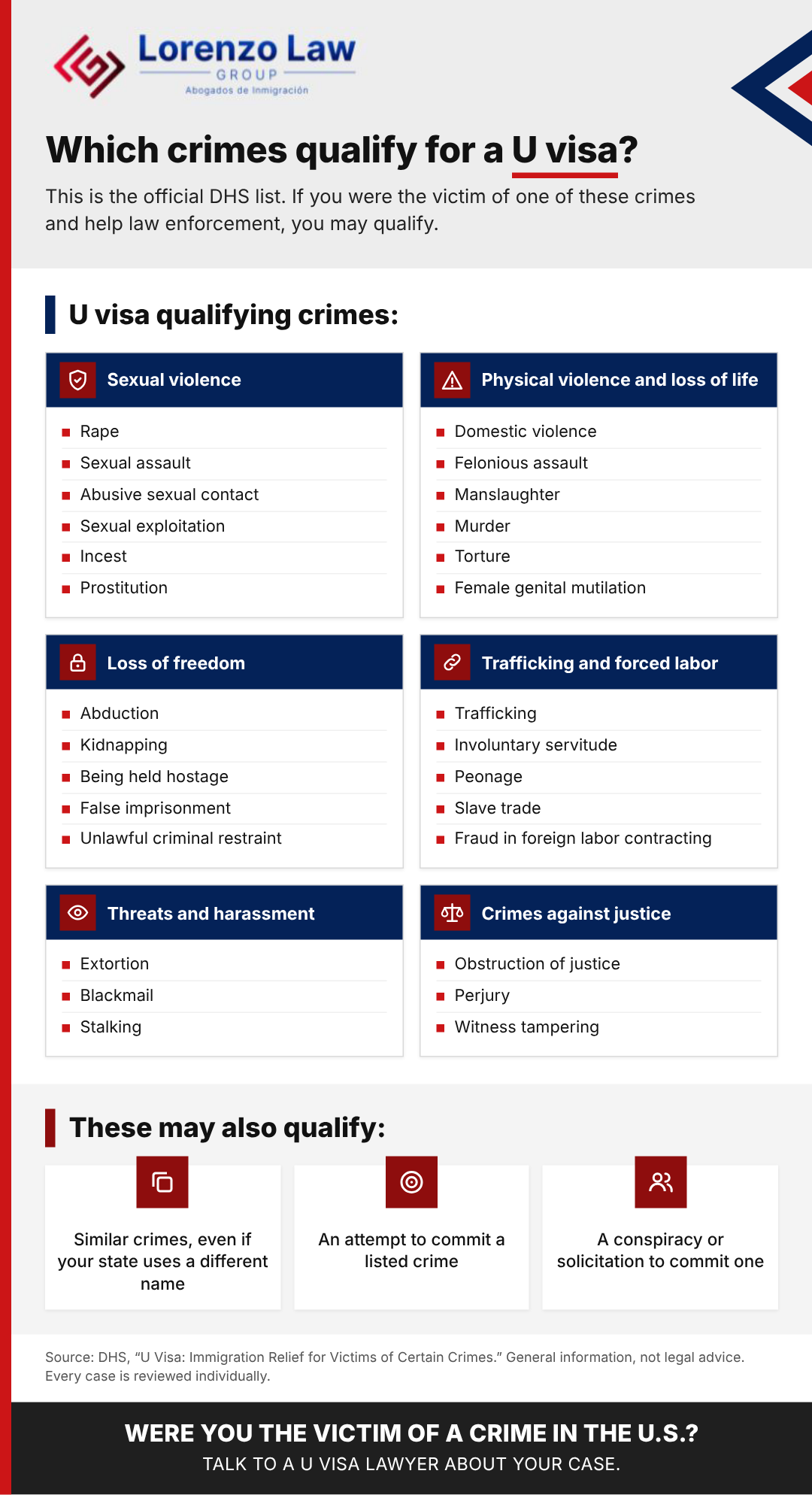
According to DHS, these are the U visa qualifying crimes:
If you are a victim of domestic violence, you may also want to look at VAWA, the Violence Against Women Act. It can help certain people abused by a U.S. citizen or permanent resident spouse or parent, or by a U.S. citizen son or daughter age 21 or older.
Similar crimes, attempts, and conspiracies
The list does not stop at the exact names above. Per DHS and federal rules (8 CFR § 214.14), a crime may also qualify if:
- Its nature and elements are substantially similar to a crime on the list. Each state names crimes differently, so what the crime involves matters more than its label.
- It is an attempt, conspiracy, or solicitation (asking someone else) to commit a listed crime.
No arrest or conviction is required. A certifying official can sign the certification even if no one was charged.
Does fraud or document theft qualify for a U visa?
General fraud and document theft are not on the DHS list. The only fraud crime on the list is fraud in foreign labor contracting.
Fraud in foreign labor contracting is a federal crime (18 U.S.C. § 1351). It happens when someone knowingly recruits or hires a person outside the U.S. for a job using materially false promises about that job.
That is different from other common types of fraud, which generally do not qualify on their own:
- Identity theft, including someone using your Social Security number
- Bank, credit card, or online scams
- A fake “notario” or immigration consultant who takes your money
Still, the facts matter. An employer who takes your passport or ID to keep you working may commit a crime tied to trafficking or forced labor (18 U.S.C. § 1592). Trafficking, involuntary servitude, and peonage are on the list.
If someone took your documents or lured you with a false job offer, ask an attorney to review what happened. The label on a police report is only part of the analysis.
Does robbery qualify for a U visa?
Robbery is not on the DHS list by name, so robbery alone usually does not qualify.
But a robbery can include conduct that is on the list. If the robber seriously attacked you or held you against your will, that conduct may count as felonious assault, false imprisonment, or kidnapping. It depends on the facts and on state law.
The certifying agency marks the type of crime on the certification form, and USCIS makes the final call. An attorney can help you understand how your case may be viewed.
Who qualifies for a U visa?
Per DHS, U.S. Citizenship and Immigration Services (USCIS) looks at whether you:
- Are a victim of a qualifying crime
- Have information about that crime
- Were, are, or are likely to be helpful in detecting, investigating, or prosecuting the crime, or in convicting or sentencing the person who committed it
Federal rules add two more qualifications for a U visa:
- You suffered substantial (serious) physical or mental abuse because of the crime.
- The crime happened in the U.S. (including its territories, Indian country, and military installations) or violated U.S. law.
You must also be admissible to the U.S. or receive a waiver. USCIS can forgive many immigration problems, such as entering without permission, through immigration waivers filed on Form I-192. It decides each waiver case by case.
Some relatives can also qualify as indirect victims. This applies when the direct victim died from murder or manslaughter, or is incompetent or incapacitated. If the victim is under 16, a parent or guardian can provide the help to law enforcement.
If your petition is approved, you can also request status for qualifying family members, such as your spouse and unmarried children under 21.
Law enforcement certification (Form I-918, Supplement B)
The certification is a form signed by a certifying official. It confirms you were a victim of a qualifying crime and have been, are, or are likely to be helpful. You must include it with your U visa petition, Form I-918. Without it, USCIS will deny your petition.
Who can sign it. Agencies that can certify include:
- Federal, state, and local law enforcement agencies
- Prosecutors and judges
- Other agencies that investigate crimes, such as child protective services, the Equal Employment Opportunity Commission (EEOC), and the Department of Labor
The person who signs must be the head of the agency, a supervisor the head has designated, or a judge.
What to know.
- The agency decides whether to sign. It is not required to.
- It can be signed at any stage of the case, even after the case is closed, whatever the outcome.
- It must be signed within the 6 months before you file your petition.
- It is evidence, not an approval. USCIS reviews all the evidence and runs its own background checks.
- The agency can withdraw it if you stop cooperating.
DHS asks certifiers to sign in blue ink with an original signature and to give the form to you, not to USCIS. You then file it with your petition.
How long does a U visa take? (processing time and waiting list)
There is no fixed U visa processing time. It depends on USCIS workloads, the annual cap, and the details of your case.
To see the current estimate, check the official USCIS processing times page. Select Form I-918 and the service center handling your case.
Why there is a U visa waiting list
The law allows only 10,000 U visas per year for principal petitioners. Family members don’t count toward that cap. USCIS has reached the cap every year since fiscal year 2010.
If USCIS finds you eligible but no visa is available, it places you on the U visa waitlist. Cases are listed in the order USCIS received them.
- While you’re on the waiting list, USCIS grants deferred action (a decision not to prioritize your removal) and may give you a work permit.
- You do not build up unlawful presence while you are on the waiting list.
- A spot on the waitlist does not guarantee approval. USCIS checks your eligibility again before it approves your case.
Before the waitlist stage, USCIS may also issue a “bona fide determination” for complete petitions that pass background checks. This can come with a work permit and deferred action. In May 2026, USCIS updated its deferred action policy, so ask an attorney how current rules apply to you.
After approval, U status lasts up to 4 years. After 3 years of continuous presence in U status, you may be able to apply for a green card. Learn how long it takes to get residency after a work permit.
Updated: October 2026.
Common reasons a U visa is denied
These are some of the most common U visa denial reasons:
- No Supplement B, or a Supplement B signed more than 6 months before filing
- The crime is not on the list and is not substantially similar to a listed crime
- Not enough evidence of substantial physical or mental abuse
- The victim did not help, or stopped helping, law enforcement
- A ground of inadmissibility that USCIS did not waive
- Fraud or false information in the petition
- Missing evidence, or no timely response to a USCIS request for evidence
If USCIS denies your petition, it will explain why in writing. You may be able to file a motion or appeal to the Administrative Appeals Office (AAO). A final denial also ends any stay of removal based on the petition.
Many of these problems can be avoided with careful preparation before you file.
How a U visa lawyer can help
A U visa case has many moving parts: the crime, the certification, the evidence, waivers, and deadlines. A lawyer can help you:
- Review whether the crime and your facts fit the qualifying crimes list
- Request the certification from the right agency
- Prepare your personal statement and supporting evidence
- File waivers and petitions for family members
- Respond to USCIS requests and plan ahead for travel or a green card
Lorenzo Law Group has offices in Reston, Virginia; Silver Spring, Maryland; and Orlando, Florida. Talk to a U visa lawyer about your case today.
Frequently asked questions
What crimes qualify for a U visa?
DHS lists 28 categories, including domestic violence, sexual assault, rape, kidnapping, extortion, stalking, and trafficking. Similar crimes, and attempts, conspiracies, or solicitations to commit them, may also qualify.
Does fraud qualify for a U visa?
Only fraud in foreign labor contracting is on the list. Most other fraud, like identity theft or scams, does not qualify on its own. It may be different if the fraud was part of trafficking or forced labor.
Does robbery qualify for a U visa?
Robbery is not on the list by name. But if the robbery involved a listed crime, such as felonious assault or false imprisonment, that conduct may qualify.
How long does a U visa take?
There is no fixed timeline. Because of the 10,000-per-year cap, many cases take years. Check USCIS processing times for the current estimate.
Do I need a police certification for a U visa?
Yes. You must include Form I-918, Supplement B, signed by a certifying official within 6 months before you file. Without it, USCIS will deny your petition.
This article is for informational purposes only and is not legal advice. Every case is different; talk to an immigration lawyer.